Spanish for Nursing: Vocabulary, Usted, and Ward Phrases
On this page
- Relevo, auxiliar de enfermería and family: who does what, what they say
- Vocabulary that goes with each task
- Ingreso, unidad and relevo
- Constantes and symptoms the patient reports
- Medicación and procedures
- Cuidados at the bedside and urgencias
- Five grammar points from usted to doler
- 1. Usted and polite imperatives
- 2. Doler: the body part is the subject
- 3. Ir a and the pronoun le: announcing what you’re about to do
- 4. Estar, ser and tener when describing symptoms
- 5. Pretérito perfecto for handover
- Two dialogues: room 218 and el relevo
- Room 218 the morning after surgery
- El relevo: night shift to morning
- Listening practice when speakers come from many places
- FAQ on nursing in Spanish
- Should I learn Spain Spanish or Latin American Spanish?
- How do enfermero and auxiliar de enfermería differ?
- usted or tú with patients?
- What’s polite to call patients?
- What DELE level do you need to nurse?
- Before your first relevo
Quarter to seven on the surgery floor of a hospital. That’s el relevo: the night nurse reads back each room for the morning shift, while the auxiliar de enfermería prepares breakfast trays. 「La 218, postoperatorio de vesícula, dolor controlado, náuseas a las cuatro.」 You catch 218 and náuseas; the rest slips past very fast.
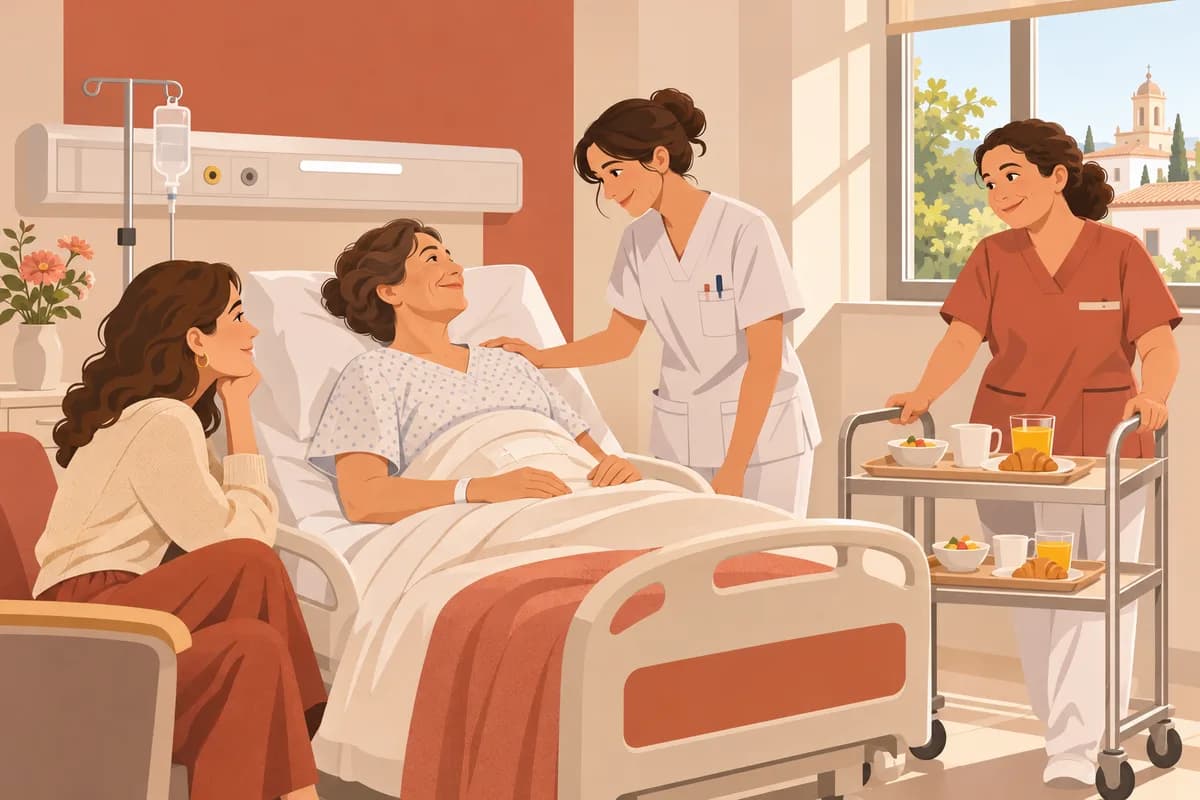
In Spain and much of Latin America, bedside care is split between enfermero or enfermera and auxiliar de enfermería (in Spain also called TCAE), and familiares often stay beside the patient, especially at night. So you talk to three groups, same level of politeness but different rhythms.
This article is for nurses working with Spanish-speaking patients, or considering moving to Spain to work. You’ll get vocabulary tables by task on shift, differences between Spain and Latin America, five grammar points you use all day, two dialogues with translation, and how to train your listening.
- Relevo, auxiliar de enfermería and family: who does what, what they say
- Vocabulary that goes with each task
- Five grammar points from usted to doler
- Two dialogues: room 218 and el relevo
- Listening practice when speakers come from many places
- FAQ on nursing in Spanish
- Before your first relevo
Relevo, auxiliar de enfermería and family: who does what, what they say
Spanish in Spain and in Latin America is the same at the core but differs in some job terms. The table below lists what you’ll hit most often on the ward. If you know where you’ll work, learn for that region.
| Meaning | Spain | Latin America (common) |
|---|---|---|
| take blood pressure | tomar la tensión | tomar la presión |
| vital signs | constantes vitales | signos vitales |
| shift handover | el relevo | la entrega de turno, el pase de guardia |
| blood test | analítica | examen de sangre, análisis |
| floor, clinical unit | planta | piso, sala |
| nursing aide for basic care | TCAE (técnico en cuidados auxiliares de enfermería) | auxiliar de enfermería |
On roles, enfermero or enfermera handles care and treatment per orders, while auxiliar de enfermería helps with hygiene, meals, and moving patients, working alongside the nurse. Titles and exact qualifications differ by country, so ask your supervisor or the ward’s jefe de enfermería what belongs to whom.
On address, with patients you use usted and call them señor or señora plus surname. With older people, many places also use don or doña plus first name, like don Manuel. In some Latin American regions people use vos, but with patients you can still stick to usted. With familiares you also use usted. Who you may tell about the patient’s condition follows local rules, so ask before discussing diagnosis.
Vocabulary that goes with each task
Spanish nouns need an article because gender affects adjectives and pronouns, so the tables include articles. Four tables follow the order of tasks in a shift. All 42 words from the game deck are here, plus extras like el timbre, las constantes vitales, la analítica and la caída.
Ingreso, unidad and relevo
| Word | Meaning | Example sentence | Translation |
|---|---|---|---|
| el paciente, la paciente | patient | El paciente de la 12 espera la analítica. | The patient in room 12 is waiting for the blood test. |
| el enfermero, la enfermera | nurse | Buenos días, soy su enfermera de hoy. | Good morning, I’m your nurse today. |
| el médico, la médica | doctor | El médico pasa visita después del desayuno. | The doctor does rounds after breakfast. |
| la unidad | ward (clinical unit) | Nuestra unidad está en la planta 6. | Our ward is on floor 6. |
| el turno | shift | Esta semana tengo turno de tarde. | This week I’m on the afternoon shift. |
| la entrega de turno | shift handover | La entrega de turno de la mañana es a las 8:00. | Morning handover is at 8:00. |
| el ingreso | admission | El ingreso de la señora Gómez es esta mañana. | Señora Gómez is being admitted this morning. |
| el alta | discharge | Le damos el alta el lunes. | We’ll discharge you on Monday. |
| los familiares | family members | Los familiares pueden pasar de cinco a ocho de la tarde. | Family may visit from 5 to 8 p.m. |
| la historia clínica | medical record | Todo queda registrado en la historia clínica. | Everything is recorded in the medical record. |
| el timbre | call bell | Pulse el timbre si necesita algo. | Press the call bell if you need anything. |
The word alta takes el even though it’s feminine: el alta. That’s a sound rule, not bad grammar, and you’ll see it in phrases like dar el alta. In Spain people also often say el relevo for shift handover.
Constantes and symptoms the patient reports
| Word | Meaning | Example sentence | Translation |
|---|---|---|---|
| la presión arterial | blood pressure | Le voy a medir la presión arterial. | I’m going to take your blood pressure. |
| el pulso | pulse | Su pulso está un poco acelerado. | Your pulse is a bit fast. |
| la temperatura | temperature | Su temperatura es de 37,2. | Your temperature is 37.2. |
| el termómetro | thermometer | Póngase el termómetro debajo del brazo. | Please put the thermometer under your arm. |
| la fiebre | fever | Tiene fiebre desde anoche. | He’s had a fever since last night. |
| el dolor | pain | ¿Qué nivel de dolor tiene, del uno al diez? | What’s your pain level, one to ten? |
| el mareo | dizziness | ¿Tiene mareos? | Are you dizzy? |
| las náuseas | nausea | ¿Siente náuseas cuando se incorpora? | Do you feel nauseous when you sit up? |
| el síntoma | symptom | ¿Qué síntomas ha notado desde la operación? | What symptoms have you noticed since the operation? |
| la alergia | allergy | ¿Tiene alguna alergia a medicamentos? | Do you have any drug allergies? |
| el estetoscopio | stethoscope | Voy a escuchar sus pulmones con el estetoscopio. | I’m going to listen to your lungs with the stethoscope. |
| las constantes vitales | vital signs | Voy a tomarle las constantes vitales. | I’m going to take your vital signs. |
mareo and náuseas often show up together in questions. Note náuseas is plural when talking about the symptom, and dolor is singular for pain in general: dolor de cabeza, dolor de espalda.
Medicación and procedures
| Word | Meaning | Example sentence | Translation |
|---|---|---|---|
| el medicamento | medication | Tome este medicamento después de comer. | Take this medication after eating. |
| la dosis | dose | La dosis la comprobamos entre dos personas. | We double-check the dose between two people. |
| la orden médica | medical order | Sin orden médica no cambiamos ninguna dosis. | Without a medical order we don’t change any dose. |
| administrar | administer (medication) | Le administro el medicamento a las ocho. | I give you the medication at eight. |
| la inyección | injection | Le voy a poner una inyección. Va a notar un pinchazo. | I’m going to give you an injection. You’ll feel a little sting. |
| la jeringa | syringe | Tiro la jeringa al contenedor de agujas. | I throw the syringe in the sharps container. |
| el suero | IV fluids, infusion | El suero tarda unas dos horas. | The IV takes about two hours. |
| la extracción de sangre | blood draw | Mañana por la mañana le haremos una extracción de sangre. | Tomorrow morning we’ll draw your blood. |
| estéril | sterile | Use solo material estéril. | Use only sterile supplies. |
| la higiene de manos | hand hygiene | La higiene de manos es lo primero antes de entrar en la habitación. | Hand hygiene comes first before entering the room. |
| en ayunas | fasting (nothing eaten) | Debe estar en ayunas para la prueba. | You must fast before the test. |
| el oxígeno | oxygen | Le pongo oxígeno, dos litros por minuto. | I’m putting you on oxygen, two liters per minute. |
| la analítica | blood test (Spain usage) | Los resultados de la analítica llegan esta tarde. | The blood test results arrive this afternoon. |
suero means IV fluid, and it also means the bag hanging on the pole. When you hear a patient say pinchazo, that’s the sting when the needle goes in. orden médica and receta differ too: la orden médica is the doctor’s order for an inpatient, and medication follows it; la receta is a prescription for outpatients or at discharge. Likewise, administrar is chart language (se le ha administrado el tratamiento), while with patients you say le doy su medicación.
Cuidados at the bedside and urgencias
| Word | Meaning | Example sentence | Translation |
|---|---|---|---|
| la herida | wound | La herida tiene buen aspecto, no hay enrojecimiento. | The wound looks good, no redness. |
| el apósito | dressing | Voy a cambiarle el apósito. | I’m going to change your dressing. |
| movilizar | turn, mobilize the patient | Movilizamos a la señora Gómez cada dos horas. | We turn señora Gómez every two hours. |
| encamado | bedridden | El señor Pérez está encamado desde la operación. | Señor Pérez has been bedridden since the operation. |
| la úlcera por presión | pressure ulcer | Cambiamos de postura cada dos horas para prevenir las úlceras por presión. | Every two hours we reposition to prevent pressure ulcers. |
| la silla de ruedas | wheelchair | Para ir a la ducha usamos la silla de ruedas. | To go to the shower we use the wheelchair. |
| la camilla | stretcher (gurney) | La camilla espera en el pasillo para llevarle a quirófano. | The stretcher is waiting in the hall to take you to the OR. |
| la caída | fall | La señora Gómez ha sufrido una caída esta noche. | Señora Gómez had a fall tonight. |
| Respire hondo | breathe deeply | Voy a auscultar sus pulmones. Respire hondo. | I’m going to listen to your lungs. Breathe deeply. |
| Acuéstese | please lie down | Para la cura, acuéstese, por favor. | For the dressing change, please lie down. |
| vigilar | monitor | Vigilamos que no le suba la fiebre durante la noche. | We watch so your fever doesn’t spike during the night. |
| las urgencias | emergency department | La señora Gómez llegó por urgencias anoche y esta mañana subió a planta. | Señora Gómez came through the ED last night and this morning went up to the ward. |
| la cirugía | surgery | La cirugía es mañana a las nueve. | Surgery is tomorrow at nine. |
movilizar in care context is broader than “turning”: it includes helping the patient sit up, stand, or walk a few steps. encamado usually describes someone who’s stayed in bed a long time. emergencia and urgencias are easy to mix up: urgencias is the emergency department, where patients often arrive before going to the ward; emergencia is an urgent situation happening now, as in es una emergencia.
Five grammar points from usted to doler
1. Usted and polite imperatives
Polite imperatives use the usted form of the verb. Reflexive or object pronouns attach to the end of the verb in affirmative sentences, and go before it in negative ones. You usually add an accent on the vowel to keep stress in place.
- Respire hondo.
- Acuéstese, por favor.
- Dígame dónde le duele.
- No se mueva.
A common mistake is using the tú form like 「Respira hondo」 with older adults, it sounds like talking to family. Another is writing or reading 「Acuestese」 without the accent, putting stress in the wrong place. You’ll also hear learners say 「Se acueste」, splitting the pronoun wrong.
2. Doler: the body part is the subject
Doler conjugates like gustar. The body part is the subject and agrees singular or plural; the person in pain uses le, me, les.
- ¿Le duele aquí?
- Me duele la cabeza.
- Me duelen las piernas.
A common mistake is 「Yo duelo」 or 「¿Usted duele?」, because learners treat doler like a verb about the person. With several body parts, the verb is plural: 「me duelen」. Drill lots of sentences with aquí, la cabeza, el pecho until it feels natural.
3. Ir a and the pronoun le: announcing what you’re about to do
Ir a plus infinitive is the most natural way to announce what’s next. The pronoun le (for usted) can go before ir or attach to the infinitive; both are correct.
- Voy a tomarle la tensión.
- Le voy a poner una inyección.
- Voy a cambiarle el apósito.
A common mistake is using usted as the object, like 「Voy a poner usted una inyección」. The pronoun must be le, and it’s required. Another is putting le in the wrong place, like 「Voy a le tomar」.
4. Estar, ser and tener when describing symptoms
Temporary states take estar: está mareado, está encamado. Lasting traits take ser: es alérgico. Symptoms take tener: tiene fiebre, tiene náuseas, tiene dolor de cabeza.
- Está un poco mareado.
- Es alérgico a la penicilina.
- Tiene mucha fiebre.
Vietnamese speakers often say 「Usted es mareado」 because Vietnamese has one word for “is” and “has/feels.” Another mistake is gender agreement: 「mucha fiebre」, not 「mucho fiebre」. Ask yourself whether it’s state, trait, or symptom before picking the verb.
5. Pretérito perfecto for handover
At handover, in Spain people often use pretérito perfecto (haber plus participle) for what just happened; in much of Latin America people often use pretérito indefinido. You’ll hear both.
- La señora Ortega ha pasado mala noche.
- Ha tenido náuseas a las cuatro.
- Se ha levantado sola a las seis.
A common mistake is pairing haber with the infinitive, like 「ha tener」 instead of 「ha tenido」. In Latin America you may hear 「Pasó mala noche」 and 「Se cayó」, both fine. Follow the usage where you work.
Two dialogues: room 218 and el relevo
Room 218 the morning after surgery
Nurse Marta enters room 218 and meets señora Ortega, first day after cholecystectomy. Her daughter sits beside her. Read all three parts aloud.
| Role | Spanish | Translation |
|---|---|---|
| Nurse | Buenos días, señora Ortega. Soy Marta, su enfermera hoy. | Good morning, señora Ortega. I’m Marta, your nurse today. |
| Patient | Buenos días. Me duele bastante aquí, en la barriga. | Good morning. It hurts quite a bit here, in my belly. |
| Nurse | ¿Del uno al diez, cuánto le duele? | From one to ten, how much does it hurt? |
| Patient | Un seis cuando me muevo. | About a six when I move. |
| Nurse | ¿Ha tenido náuseas o mareo desde la operación? | Since the operation, have you had nausea or dizziness? |
| Patient | Náuseas un poco, mareo no. | A little nausea, no dizziness. |
| Nurse | Voy a tomarle la tensión y la temperatura. Después miro la orden médica y le pongo algo para el dolor. | I’ll take your blood pressure and temperature. Then I’ll check the order and give you something for pain. |
| Family | Perdone, ¿puede levantarse hoy? Es que ayer el médico dijo que había que empezar a moverla. | Excuse me, can she get up today? Yesterday the doctor said we needed to start getting her moving. |
| Nurse | Sí, pero con ayuda. Primero la movilizamos con la auxiliar y luego la sentamos en el sillón. No se levante sola, por favor. Si necesita algo, pulse el timbre. | Yes, but with help. First we mobilize her with the aide, then we sit her in the armchair. Please don’t get up alone. If you need anything, press the call bell. |
El relevo: night shift to morning
Handover in Spain often follows four parts: patient, what happened overnight, pending tasks, and info for family. The speaker uses pretérito perfecto for what already happened. Read each line aloud, slowly and clearly.
| Section | Spanish | Translation |
|---|---|---|
| Patient | Habitación 218, la señora Ortega, 58 años, primer día postoperatorio de una colecistectomía. | Room 218, señora Ortega, 58, first day post-op after cholecystectomy. |
| Overnight | Ha tenido dolor de seis sobre diez al moverse y náuseas a las cuatro. Se le ha administrado el tratamiento y ha mejorado. Sin fiebre, 36,8. | Pain six out of ten when moving and nausea at four. Treatment given per order and she improved. No fever, 36.8. |
| Pending | El suero termina a las doce. Mañana a primera hora, analítica en ayunas. La herida: apósito limpio y seco. | IV finishes at twelve. First thing tomorrow, fasting blood test. Wound: dressing clean and dry. |
| Family | La hija pasará la noche con ella. Si hay fiebre o más dolor, avisar al médico. | Her daughter will stay with her tonight. If fever or more pain, notify the doctor. |
Listening practice when speakers come from many places
Start with the job vocabulary in Falling Stars or Pop It, and say the full article aloud as you play. Then read each example sentence above, especially ones with le, that’s where Vietnamese speakers trip most.
Spanish has many accents, and every ward has patients or colleagues from elsewhere, so diversify listening practice. Open an episode from the Spanish podcast list, transcribe line by line, and check against the original. Transcription helps you catch verb endings and small pronouns like le, se, me, the things new ears skip. See courses if you want a path, and use the vocabulary test for a baseline.
Beyond WELE, Instituto Cervantes, which runs DELE, has online materials and courses; podcast Radio Ambulante tells stories in Latin American Spanish and fits listening practice well. Both are general Spanish, not nursing-specific, so specialty terms still come from the tables above and from colleagues. If you want to nurse in Spain, foreign credentials need recognition (homologación) and licensing depends on regional rules. Procedures and language requirements change over time, so check with the authority that applies. When you want to gauge level, DELE mock tests on WELE give you a marker.
Rotating shifts make a fixed hour hard, so smaller chunks usually work better. If bedside care is also your target, see Spanish for elderly care and Spanish for hotels, or browse all Spanish by profession and the nursing page.
FAQ on nursing in Spanish
Should I learn Spain Spanish or Latin American Spanish?
Learn for where you’ll work. Core grammar and most nursing vocabulary overlap; the difference is a small set of terms like in the table at the top. If you don’t know yet, start with the shared part and switch once you know.
How do enfermero and auxiliar de enfermería differ?
Enfermero or enfermera is the nurse, responsible for care and treatment per orders. Auxiliar de enfermería, in Spain, TCAE, helps with basic care: hygiene, meals, mobility, working with the nurse. In Latin America titles and qualifications differ by country, so ask where you work.
usted or tú with patients?
Use usted with adult patients. tú is usually for close colleagues or children, and in some regions the line is looser. If unsure, usted is rarely wrong.
What’s polite to call patients?
Señor or señora plus surname, like señor Pérez. With older people, don or doña plus first name is common in many places. Avoid bare first names until you know them well.
What DELE level do you need to nurse?
There’s no single standard; employers or licensing bodies set their own requirements and they can change. Ask the place you’re targeting directly, then use mock tests to see where you stand.
Before your first relevo
If your first relevo has a date, run one round of Falling Stars with the nursing deck, articles included out loud, so la orden médica, el suero and las urgencias aren’t strangers when the night shift reads their part.
