Spanish for Drivers: Group Pickups, Vocabulary, Phrases, and Dialogues
On this page
- Driving a group in Saigon: ustedes, vosotros, and where passengers are from
- Vocabulary, from Tan Son Nhat to the downtown area
- Picking up a passenger group
- Suitcases and seating in the car
- Tourists from the airport to the hotel
- Route, traffic, and turns
- Fare, dollars, and forgotten items
- Grammar: five spots to get solid
- 1. Usted and ustedes: one person or the whole group
- 2. Formal imperatives: abróchese, abróchense
- 3. Les, se lo, se las: object pronouns
- 4. Ser and estar: place and condition
- 5. Money amounts and irregular hundreds
- Dialogues: seven suitcases, an ATM, a camera on WhatsApp
- The Ramírez family at the airport
- Stopping at an ATM and paying at the end of the trip
- WhatsApp message about the camera
- Practice between pickup runs
- What drivers often wonder
- Tú or usted with passengers?
- Do passengers tip?
- How do passengers from Spain and Mexico differ?
- How much Spanish do you need to drive passengers?
- What do you need to drive in Spain or Latin America?
- Before the next pickup
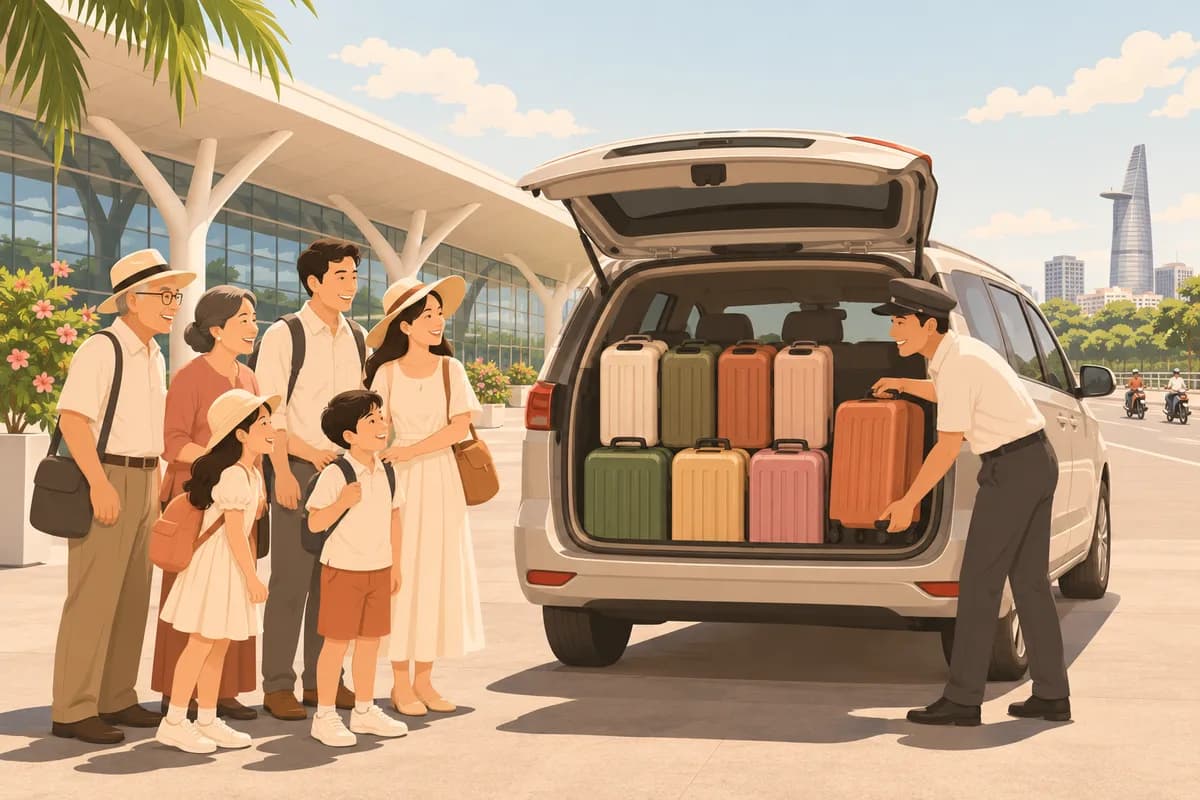
Midday at Tan Son Nhat Airport, Saigon. Six people from a Mexican family walk out of the arrivals hall with seven suitcases and the faces of people who just flew for ten-plus hours. Mrs. Ramírez comes toward your name sign and asks, smiling, whether your car can fit everything. You catch “caben” and “maletas”. What you do not know yet is how to say that suitcases go in the cajuela, this trip takes about an hour if there is traffic, and “ustedes” becomes “vosotros” if the passengers are from Madrid.
Spanish is the language of a growing tourist group in Vietnam, and with contract cars for large groups you are often the first person they meet. This job differs from driving Grab in that passengers travel as a group, so you speak to several people at once, and grammar shifts accordingly: usted for one person, ustedes for the whole group. If you drive in Spain or Latin America, this set of phrases still applies.
This article includes vocabulary tables along the route from the airport to the downtown area, five grammar points (usted and ustedes, formal imperatives, object pronouns le, les, se lo, ser and estar, irregular hundreds), three dialogues, and how to practice. It ends with a set of 40 words you can use in real situations.
- Driving a group in Saigon: ustedes, vosotros, and where passengers are from
- Vocabulary, from Tan Son Nhat to the downtown area
- Grammar: five spots to get solid
- Dialogues: seven suitcases, an ATM, a camera on WhatsApp
- Practice between pickup runs
- What drivers often wonder
- Before the next pickup
Driving a group in Saigon: ustedes, vosotros, and where passengers are from
Spanish is not uniform across countries. Passengers from Spain use vosotros for informal groups and ustedes in formal settings. Passengers from Mexico, Argentina, and most of Latin America use ustedes for every group. With passengers as a driver, the safest approach is usted when speaking to one person and ustedes when speaking to a group, and recognizing vosotros when passengers use it.
| Meaning | Spain | Latin America | Notes |
|---|---|---|---|
| trunk | el maletero | la cajuela (México), el baúl (Argentina y otros) | Ask passengers once what they call it. |
| car | el coche | el carro o el auto | All three work in context. |
| traffic jam | el atasco | el embotellamiento, el tráfico | Trancón in Colombia. |
| rush hour | la hora punta | la hora pico | Latin American speakers often say hora pico. |
| parking lot | el aparcamiento | el estacionamiento | Estacionamiento is understood in both places. |
| change (money) | el cambio | el cambio, el vuelto | Vuelto is common in many South American countries. |
You do not need to learn both ways of saying everything. Pick one form for yourself, for example maletero and estacionamiento, then listen for which words passengers use and switch when needed. Passengers are usually pleased when you use the name they use for a thing.
On tipping: in Spain and many Latin American countries a small tip is normal, at least when passengers are satisfied, and passengers usually do not mind giving one. The amount depends on country and person, so you should not guess. You accept it, say muchas gracias, and do not refuse for too long.
Vocabulary, from Tan Son Nhat to the downtown area
Spanish nouns are learned with the article el or la, and gender you already know helps you agree adjectives correctly. The tables follow trip order. When speaking to a group, use ustedes in examples, and translations use “everyone” or “you all”.
Picking up a passenger group
| Word | Meaning | Example sentence | Translation |
|---|---|---|---|
| el pasajero | passenger | ¿Cuántos pasajeros viajan hoy? | How many passengers are riding today? |
| el conductor | driver | Soy su conductor, me llamo Nguyen. | I am your driver; my name is Nguyen. |
| el viaje | ride, trip | El viaje dura unos cuarenta minutos. | The trip takes about 40 minutes. |
| la reserva | booking | Tengo su reserva a nombre de Ramírez. | I have your booking under the name Ramírez. |
| el punto de recogida | pickup point | ¿Es este el punto de recogida? | Is this the pickup point? |
| el destino | destination | ¿Cuál es su destino? | What is your destination? |
| la dirección | address | ¿Me muestran la dirección, por favor? | Could you show me the address, please? |
| recoger | pick up (passengers) | Los recojo en diez minutos. | I will pick you up in ten minutes. |
| dejar | drop off | Los dejo justo en la puerta del hotel. | I will drop you off right at the hotel door. |
| cancelar | cancel (the trip) | Si necesitan cancelar, avísenme antes. | If you need to cancel, please tell me ahead of time. |
The verbs recoger and dejar usually go with los or las: los recojo, los dejo. Note that los is for a group with at least one man; las is only when the whole group is women.
Suitcases and seating in the car
| Word | Meaning | Example sentence | Translation |
|---|---|---|---|
| el equipaje | luggage | ¿Cuánto equipaje llevan? | How much luggage are you carrying? |
| el maletero | trunk | Pongo las maletas en el maletero. | I put the suitcases in the trunk. |
| el cinturón de seguridad | seat belt | Abróchense el cinturón de seguridad, por favor. | Please buckle your seat belts. |
| la silla infantil | child seat | La silla infantil está en la fila de atrás. | The child seat is in the back row. |
| el aire acondicionado | air conditioning | ¿Les parece bien el aire acondicionado? | Is the air conditioning okay for you? |
Seven suitcases for six people is common for families on long trips. Say plainly if the car cannot fit everything: 「Con siete maletas, tenemos que poner dos en la fila de atrás」. Passengers usually accept it if you explain before loading, but they get annoyed if you just do it without saying anything.
Tourists from the airport to the hotel
| Word | Meaning | Example sentence | Translation |
|---|---|---|---|
| el aeropuerto | airport | Al aeropuerto tardamos unos cuarenta y cinco minutos. | To the airport it takes us about 45 minutes. |
| la terminal | terminal | ¿En qué terminal los dejo? | Which terminal should I drop you at? |
| el hotel | hotel | El hotel está a diez minutos del centro. | The hotel is ten minutes from downtown. |
| el turista | tourist | En esta zona hay muchos turistas. | There are many tourists in this area. |
Spanish and Latin American passengers often ask about food, exchanging money, and pharmacies from the first ride. Have three words ready: casa de cambio (currency exchange), cajero automático (ATM), and farmacia (pharmacy). A line like 「Hay un cajero automático aquí cerca」 reassures passengers a lot.
Route, traffic, and turns
| Word | Meaning | Example sentence | Translation |
|---|---|---|---|
| el atasco | traffic jam | Hay un atasco en la avenida principal. | There is a jam on the main avenue. |
| la hora punta | rush hour | En hora punta tardamos más. | During rush hour we take longer. |
| el desvío | detour | Hay obras, así que tomo un desvío. | There is roadwork, so I am taking a detour. |
| el atajo | shortcut | Conozco un atajo, si les parece bien. | I know a shortcut, if that works for you. |
| el peaje | toll | En esta ruta hay un peaje, se lo aviso. | There is a toll on this route; I am letting you know ahead of time. |
| la autopista | highway | ¿Prefieren ir por la autopista? | Would you prefer to take the highway? |
| el cruce | intersection | En el próximo cruce giro a la derecha. | At the next intersection I will turn right. |
| girar a la izquierda | turn left | Más adelante tengo que girar a la izquierda. | A little farther ahead I have to turn left. |
| girar a la derecha | turn right | Enseguida voy a girar a la derecha. | I am about to turn right. |
| el límite de velocidad | speed limit | Aquí hay un límite de velocidad, voy despacio. | There is a speed limit here, so I am slowing down. |
| el estacionamiento | parking lot | El estacionamiento está detrás del edificio. | Parking is behind the building. |
| el combustible | fuel | Necesito echar combustible, ¿les parece bien? | I need to get fuel; is that okay with you? |
| el GPS | GPS, navigation | Pongo la dirección en el GPS. | I enter the address in the GPS. |
When giving directions, Spanish uses a la derecha, a la izquierda, todo recto (or derecho in Latin America), al final de la calle. Passengers often say 「siga derecho」 to tell you to keep going straight. You should recognize both todo recto and derecho.
Fare, dollars, and forgotten items
| Word | Meaning | Example sentence | Translation |
|---|---|---|---|
| la tarifa | fare | La tarifa es de 350.000 dong. | The fare is 350,000 dong. |
| el pago | payment | El pago se puede hacer en efectivo o con tarjeta. | Payment can be cash or card. |
| el efectivo | cash | Aceptamos efectivo en dong y en dólares. | We accept cash in dong and dollars. |
| el recibo | receipt | ¿Quieren un recibo? | Do you need a receipt? |
| la propina | tip | Muchas gracias por la propina. | Thank you very much for the tip. |
| la valoración | rating, review | Si el viaje les gustó, una buena valoración me ayuda mucho. | If you enjoyed the trip, a good review helps me a lot. |
| el objeto perdido | lost item | Si encuentro un objeto perdido, los aviso enseguida. | If I find a lost item, I will tell you right away. |
| la licencia de conducir | driver’s license | Mi licencia de conducir y los papeles del vehículo están en regla. | My license and vehicle papers are in order. |
If you accept dollars, state how you calculate clearly. A line like 「Aceptamos dólares, y el cambio se lo doy en dong」 avoids arguments at the end of the trip, because passengers may want to know the rate you use and what currency you give for change.
Grammar: five spots to get solid
1. Usted and ustedes: one person or the whole group
With one passenger, use usted and third-person singular verb forms: usted quiere, usted va. With a group, use ustedes and third-person plural: ustedes quieren, ustedes van. In direct speech, Spanish speakers often drop the pronoun and keep only the verb.
- ¿Quiere que le ayude con las maletas?
- ¿Quieren aire acondicionado?
- ¿A dónde van, por favor?
A common mistake for Vietnamese speakers is using tú (tú quieres) because it is short or because Vietnamese does not split tú and usted the same way. With strangers, usted is always correct. When a passenger from Spain says 「¿Queréis que paremos?」, that is vosotros; you only need to recognize it.
2. Formal imperatives: abróchese, abróchense
Imperatives with usted use the ending -e or -a; with ustedes add -n: pase, pasen; suba, suban; espere, esperen. Reflexive verbs attach the pronoun to the ending: abróchese, abróchense. Adding por favor is enough.
- Suban, por favor.
- Abróchense el cinturón, por favor.
- Esperen un momento, por favor.
Learners often use the infinitive for everything: 「Abrochar cinturón」. That is still understood but sounds like a sign. They also confuse the tú form, like 「abróchate」, which is only for people you are close to.
3. Les, se lo, se las: object pronouns
Spanish puts pronouns before the verb: les ayudo, los recojo. When there are two pronouns, le and les become se before lo, la, los, las: se lo digo, se las pongo.
- Les ayudo con las maletas.
- Se las pongo en el maletero.
- Se lo aviso antes del peaje.
A common mistake is dropping pronouns, like 「Ayudo maletas」, or placing them after the verb Vietnamese-style. Listeners still understand, but the sentence lacks polish. Learn les ayudo as a chunk.
4. Ser and estar: place and condition
Estar is for location and temporary state: el hotel está cerca, el tráfico está pesado. Ser is for traits and identity: soy su conductor, es una zona turística.
- El hotel está a diez minutos.
- El tráfico está pesado hoy.
- Soy su conductor.
- Es una zona muy turística.
Vietnamese does not split the two verbs that way, so Vietnamese speakers often use ser for everything: 「El hotel es cerca」. Quick rule: if you are saying where something is or how things are right now, use estar.
5. Money amounts and irregular hundreds
Spanish numbers are tricky in the hundreds: 500 is quinientos, not cincocientos; 700 is setecientos and 900 is novecientos. Large numbers read by thousands like Vietnamese, so 250,000 is doscientos cincuenta mil.
| Number | Spanish |
|---|---|
| 250.000 | doscientos cincuenta mil |
| 350.000 | trescientos cincuenta mil |
| 500.000 | quinientos mil |
| 700.000 | setecientos mil |
| 900.000 | novecientos mil |
A common mistake is saying 「cincocientos」 or 「sietecientos」 from simple blending. The fix is to learn the five irregular forms: quinientos, setecientos, novecientos, and also remember that 100 alone is cien, but before other numbers it is ciento.
Dialogues: seven suitcases, an ATM, a camera on WhatsApp
The Ramírez family at the airport
Mrs. Ramírez is with five relatives. Read both roles aloud.
| Role | Spanish | Translation |
|---|---|---|
| Driver | Buenas tardes, ¿son ustedes la familia Ramírez? Soy su conductor, me llamo Nguyen. | Good afternoon, are you the Ramírez family? I am your driver; my name is Nguyen. |
| Mrs. Ramírez | Sí, somos nosotros. Son seis personas y siete maletas. | Yes, that is us. Six people and seven suitcases. |
| Driver | Perfecto. Les ayudo con el equipaje. Cinco maletas van en el maletero y dos en la fila de atrás. | Perfect. I will help you with the luggage. Five suitcases go in the trunk and two in the back row. |
| Mrs. Ramírez | Está bien. ¿Cuánto tarda hasta el hotel? | All right. How long until the hotel? |
| Driver | Con el tráfico, una hora más o menos. Abróchense el cinturón, por favor. | With traffic like this, about an hour. Please buckle your seat belts. |
| Mrs. Ramírez | Perfecto. Y oiga, ¿hay un cajero automático cerca del hotel? | Perfect. And listen, is there an ATM near the hotel? |
| Driver | Sí, hay uno a dos minutos. Los dejo en la puerta y les enseño dónde está. | Yes, one or two minutes away. I will drop you at the door and show you where it is. |
Stopping at an ATM and paying at the end of the trip
| Role | Spanish | Translation |
|---|---|---|
| Driver | Señora, hay un atasco en la avenida principal. ¿Les parece bien si tomo un desvío? | Madam, there is a jam on the main avenue. Would you be okay if I take a detour? |
| Mrs. Ramírez | Sí, claro. ¿Tardamos mucho más? | Yes, of course. Will we take much longer? |
| Driver | Unos diez minutos más, pero no estamos parados. Ya llegamos. | About ten more minutes, but we are not standing still. We are almost there. |
| Mrs. Ramírez | Gracias. ¿Cuánto es? | Thank you. How much is it? |
| Driver | La tarifa es de 350.000 dong. Aceptamos efectivo en dong y en dólares. | The fare is 350,000 dong. We accept cash in dong and dollars. |
| Mrs. Ramírez | Le doy dólares. ¿Me da un recibo? | I will give you dollars. Can I have a receipt? |
| Driver | Claro. El cambio se lo doy en dong, ¿le parece bien? | Of course. I will give you change in dong, is that okay? |
| Mrs. Ramírez | Perfecto. Quédese con el cambio, es la propina. | Perfect. Keep the change; that is the tip. |
| Driver | Muchas gracias, señora. Que disfruten de Saigón. | Thank you very much, madam. Enjoy Saigon. |
WhatsApp message about the camera
| Role | Spanish | Translation |
|---|---|---|
| Passenger | Hola, soy Marta, ayer viajamos con usted desde el aeropuerto. Creo que se me quedó la cámara en el coche. | Hi, I am Marta; yesterday we rode with you from the airport. I think I left my camera in the car. |
| Driver | Hola, Marta. Déjeme revisar. Sí, la encontré debajo del asiento trasero. | Hi, Marta. Let me check. Yes, I found it under the back seat. |
| Passenger | Qué alivio. ¿Puedo pasar a recogerla? | What a relief. Can I come pick it up? |
| Driver | Se la llevo al hotel esta tarde. ¿A qué hora le viene bien? | I will bring it to your hotel this afternoon. What time works for you? |
| Passenger | A las seis, en recepción. Muchas gracias. | At six, at reception. Thank you very much. |
This section has a phrase worth remembering: 「se me quedó la cámara」, literally the camera stayed with me. Spanish speakers use this structure to talk about forgotten items without blaming themselves directly, so when you hear it, you know the next step is to check the car right away.
Practice between pickup runs
When you play Falling Stars or Pop It, do not forget noun gender: say el maletero, la tarifa. Getting gender wrong is a small error, but Spanish speakers notice immediately, and it will follow you into adjectives and pronouns too.
Transcribe a segment from the Spanish podcast and watch for swallowed final sounds, like -s and -d, then compare with the original. If you need a path, see the courses, and take the vocabulary test to see how many words you already know.
Outside WELE: SpanishDict is a free dictionary and verb conjugator, useful when a passenger texts an unfamiliar verb. Instituto Cervantes, which runs the DELE exam, publishes sample papers. To gauge your level, take a DELE mock test on WELE.
If you do related work too, read Spanish for hotels and Spanish for tour guides. The full category is at Spanish by profession, and the driver page collects articles for this job.
What drivers often wonder
Tú or usted with passengers?
With strangers, usted is always correct everywhere Spanish is spoken, and ustedes for the whole group. Switch to tú only when the passenger clearly invites it, and many drivers keep usted for the whole trip anyway.
Do passengers tip?
Usually yes, but amounts and habits vary by country and by person. You do not need to ask or wait. Accept when offered, say muchas gracias, and if the passenger says quédese con el cambio, keep the change.
How do passengers from Spain and Mexico differ?
They differ in some words and pronunciation, for example maletero and cajuela, vosotros and ustedes, atasco and embotellamiento. Most passengers understand each other’s general accent, and you can learn from how they speak and mirror it back.
How much Spanish do you need to drive passengers?
There is no required certificate for this work. The set of 40 words plus about twenty fixed sentences at beginner level is usually enough for most trips. Longer conversations passengers often handle with a translation app.
What do you need to drive in Spain or Latin America?
Ask the traffic authority and hiring company in your target country directly about passenger licenses, residency status, and language requirements, because rules differ by country, by city, and change over time. The Spanish side of the job is close to what this article teaches.
Before the next pickup
Pick three lines from the tables, for example 「Los recojo en diez minutos」, 「Abróchense el cinturón」, and 「Muchas gracias」, and practice saying them aloud until you do not stumble. Then play one round of Falling Stars so the words stick.
