Spanish for Hotels and Homestays: Vocabulary, Usted, Todo Incluido, and Sold-Out Rooms
On this page
- How to address guests at a resort
- Vocabulary table for a guest’s stay
- Lobby, booking, check-in
- Room and in-room items
- Housekeeping and services
- Payment, check-out, complaints, reviews
- Two regions, two word sets: comparison table
- Five grammar points for the front desk
- 1. Usted, guest surnames, and opening lines
- 2. Imperativo formal: Pase, Firme, Espere
- 3. Polite requests: ¿Podría…? ¿Me permite…? ¿Le importaría…?
- 4. Ser, estar, and hay: talking about rooms, times, and services
- 5. Pronouns le, lo, la, and se la
- Todo incluido check-in and handling a booked room that is no longer available
- Resort check-in at midday
- Telling a guest their booked room is no longer available
- Pronunciation and listening practice
- Quick questions
- What level of Spanish does hotel front desk work require?
- What if a guest uses tú or vos with me?
- How do estancia and estadía differ?
- What are sobreventa and overbooking, and how do you tell a guest?
- How do planta, piso, and primera planta differ?
- First small task
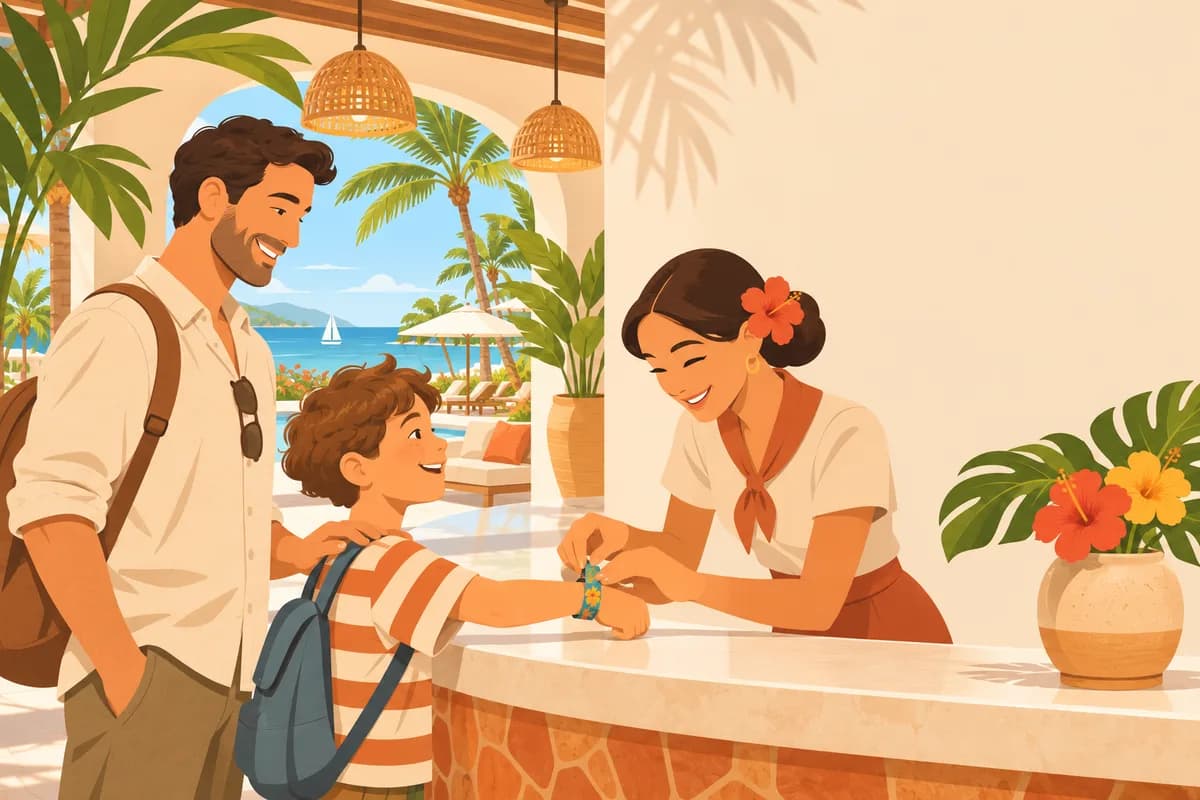
At 12:30 p.m., the check-in line at a seaside resort stretches to the door. A man at the front of the queue says: 「Buenos días, tenemos una reserva a nombre de Ramírez, todo incluido. ¿Ya está lista la habitación? Mi hijo pregunta si le dan ya la pulsera.」. You recognize reserva and habitación, but you need to know what todo incluido means here: meals, drinks, and a wristband (pulsera) to get into the restaurant. The boy is standing beside him in swimwear, and you have a few seconds to answer with the right form of address.
Spanish at the front desk runs on a small set of patterns that repeat all day. This article is for front desk, housekeeping, and homestay hosts in Vietnam welcoming Spanish-speaking guests, and for anyone learning to work in hotels or resorts in Spain or Latin America. The two regions differ in some words and forms of address, so the article includes a separate comparison table.
It covers forms of address, vocabulary tables, a two-region comparison table, five grammar points, two scenarios (todo incluido check-in and having to tell a guest their booked room is no longer available), and how to practice. At the end there is a word set you can use in a game right away.
- How to address guests at a resort
- Vocabulary table for a guest’s stay
- Two regions, two word sets: comparison table
- Five grammar points for the front desk
- Todo incluido check-in and handling a booked room that is no longer available
- Pronunciation and listening practice
- Quick questions
- First small task
How to address guests at a resort
With guests, staff always use usted and address them as señor or señora plus surname, as in señor Ramírez. Greetings change by time of day: buenos días in the morning, buenas tardes from midday through the afternoon, buenas noches when it is dark.
| Situation | Common phrase | Example |
|---|---|---|
| Greeting a guest who just arrived | Buenos días, buenas tardes, buenas noches | Buenos días, bienvenidos al resort. |
| Asking about a booking | ¿Tienen una reserva? ¿A nombre de quién? | ¿A nombre de quién, por favor? |
| Asking the guest to wait | Un momento, por favor | Un momento, por favor, lo compruebo. |
| Replying to thanks | De nada, no hay de qué, con mucho gusto | Con mucho gusto, señor. |
Many Latin American guests are used to vos or tú, and may speak to you with vos, as in 「¿Tenés una habitación?」. You still reply with usted. When speaking to a group of guests, use ustedes, in both Spain and Latin America. Vosotros is only for close friends.
Vocabulary table for a guest’s stay
The tables run from when the guest walks in until they leave. The game’s set of 40 words is in these tables, plus some extra words like pulsera, todo incluido, botones, and parte de viajeros. Meanings in the table match the game; extra notes are in parentheses.
Lobby, booking, check-in
| Word | Meaning | Phrase with a guest | Translation |
|---|---|---|---|
| huésped | guest staying at the property | Los huéspedes pueden usar la piscina desde las nueve de la mañana. | Guests can use the pool from 9 a.m. |
| recepcionista | front desk staff | Me llamo Hoa y soy recepcionista. | My name is Hoa and I work at the front desk. |
| recepción | front desk | Para cualquier cosa, marque el cero y le atiende recepción. | For anything you need, dial 0 and the front desk will answer. |
| anfitrión | host (homestay) (fem.: anfitriona) | Soy su anfitrión, vivo en la casa de al lado y estoy disponible por teléfono. | I am your host, I live in the house next door, and you can reach me by phone. |
| casa de huéspedes | homestay | Es una casa de huéspedes pequeña, con cuatro habitaciones y terraza. | This is a small guesthouse with four rooms and a terrace. |
| reserva | booking | No encuentro su reserva. ¿Podría decirme con qué nombre la hizo? | I cannot find your booking. Could you tell me what name it is under? |
| check-in | check-in | El check-in empieza a las tres de la tarde, pero su habitación ya está lista. | Check-in starts at 3 p.m., but your room is already ready. |
| llave de la habitación | room key | Esta es la llave de la habitación 418. | This is the key to room 418. |
| pasaporte | passport | Necesito su pasaporte para rellenar el parte de viajeros. | I need your passport to fill out the guest registration form. |
| equipaje | luggage | El botones sube el equipaje a la habitación. | The bellhop will take the luggage up to the room. |
In Spain, guests must fill out a guest registration form called parte de viajeros, and foreign guests show their pasaporte. The word check-in is widely used; on official paperwork you will see registro de entrada. At resorts there is also pulsera, the wristband that identifies todo incluido guests.
Room and in-room items
| Word | Meaning | Phrase with a guest | Translation |
|---|---|---|---|
| habitación individual | single room | Le he reservado una habitación individual interior, más tranquila. | I have reserved a quieter interior single room for you. |
| habitación doble | double room | La habitación doble tiene vistas al mar. | The double room has sea views. |
| suite | suite | La suite tiene una terraza privada. | The suite has a private terrace. |
| cama supletoria | extra bed (in Latin America people also say cama adicional) | Para su hija ponemos una cama supletoria. | We will add an extra bed for your daughter. |
| toalla | towel | Las toallas de piscina se recogen en recepción con la pulsera. | Pool towels are collected at the front desk when you show the wristband. |
| sábana | bed sheet | ¿Quiere que cambiemos las sábanas hoy? | Would you like us to change the sheets today? |
| almohada | pillow | Hay almohadas extra en el armario. | There are extra pillows in the wardrobe. |
| manta | blanket | Si tiene frío, le traigo otra manta. | If you are cold, I will bring another blanket. |
| aire acondicionado | air conditioning | El aire acondicionado se enciende con el mando. | The air conditioning is turned on with the remote. |
| minibar | minibar | El agua del minibar está incluida, el resto se cobra aparte. | Water in the minibar is included; everything else is charged separately. |
| caja fuerte | safe | La caja fuerte se cierra con un código de cuatro cifras. | The safe locks with a four-digit code. |
| contraseña del wifi | Wi-Fi password | La contraseña del wifi viene en la tarjeta de bienvenida. | The Wi-Fi password is on the welcome card. |
Watch noun gender because it changes the article: el aire acondicionado, la manta, la caja fuerte, el minibar. Words ending in -o are usually masculine and in -a usually feminine, but aire, minibar, and suite do not follow that rule. Copy each noun with its article.
Housekeeping and services
| Word | Meaning | Phrase with a guest | Translation |
|---|---|---|---|
| camarera de piso | housekeeping staff (masc.: camarero de piso) | La camarera de piso pasa cuando usted sale de la habitación. | Housekeeping comes when you leave the room. |
| limpiar | clean the room | ¿Quiere que limpiemos la habitación ahora o más tarde? | Would you like us to clean the room now or later? |
| no molestar | do not disturb (door sign) | Si cuelga el cartel de «No molestar», no entramos. | If you hang this sign, we will not enter. |
| servicio de lavandería | El servicio de lavandería recoge la ropa hasta las diez de la mañana. | Laundry service picks up clothes until 10 a.m. | |
| llamada de despertador | wake-up call | Para la llamada de despertador necesito su número de habitación. | For the wake-up call I need your room number. |
| traslado al aeropuerto | airport transfer | El traslado al aeropuerto se reserva el día anterior. | Airport transfer must be booked the day before. |
| desayuno | breakfast | El desayuno es un buffet, de siete y media a diez y media. | Breakfast is a buffet, from 7:30 to 10:30. |
| objeto perdido | lost property | Su gorra está en recepción como objeto perdido. | Your cap is at the front desk as lost property. |
When knocking, staff usually say 「Servicio de habitaciones」 or 「Limpieza」 and wait for an answer before entering. Note that the verb after que switches to subjunctive (limpiemos).
Payment, check-out, complaints, reviews
| Word | Meaning | Phrase with a guest | Translation |
|---|---|---|---|
| check-out | check-out | El check-out es hasta las doce. | Check-out is by 12 o’clock. |
| salida tardía | late check-out | La salida tardía es posible hasta las cuatro, con un suplemento. | Late check-out is possible until 4 p.m., with a surcharge. |
| factura | invoice | ¿Quiere la factura a nombre de la empresa? | Would you like the invoice in the company name? |
| depósito | deposit | El depósito se devuelve al hacer el check-out. | The deposit is refunded at check-out. |
| propina | tip | La propina es voluntaria. | Tipping is optional. |
| cancelar | cancel a booking | Puede cancelar gratis hasta cuarenta y ocho horas antes de la llegada. | You can cancel free of charge up to 48 hours before arrival. |
| completo | fully booked | Esta semana estamos completos; si quiere, le apunto en la lista de espera. | We are fully booked this week; if you wish, I will put you on the waiting list. |
| alojarse | stay overnight | ¿Cuántas noches van a alojarse con nosotros? | How many nights will you be staying with us? |
| queja | complaint | Si tiene una queja, la anoto y se la paso a la dirección. | If you have a complaint, I will note it and pass it to management. |
| reseña | guest review | Le agradeceríamos una reseña en internet. | We would appreciate a review online. |
In Spain, propina is not mandatory and is often just rounding up; in some Latin American countries, tips are expected more and are sometimes already on the bill. Ask colleagues which custom applies where you work.
Two regions, two word sets: comparison table
Guests from the two regions may use different words for the same thing. The table below lists only words commonly heard in hotels. Words in the game set work in both regions, except cama supletoria, which is the Spanish usage.
| Concept | Spain | Latin America (common) |
|---|---|---|
| elevator | ascensor | elevador |
| room | habitación | habitación, cuarto, pieza (Chile, Argentina) |
| housekeeping staff | camarera de piso | camarista (México), mucama (Argentina, Uruguay) |
| suitcase | maleta | maleta, valija (Argentina) |
| ground floor | planta baja | planta baja |
| floor right above | primera planta | primer piso |
| stay | estancia | estadía |
If you are not sure where a guest is from, use neutral words like habitación, equipaje, and recepción, then listen to how the guest speaks and reply with their words. An Argentine says valija and you reply maleta, they will still understand, but replying with valija will make them feel heard.
Five grammar points for the front desk
1. Usted, guest surnames, and opening lines
Opening lines combine a greeting, señor or señora, and an open question. Use ¿Tienen una reserva? and ¿En qué puedo ayudarles? so guests state what they need. Verbs conjugate in the third person when speaking to usted, and third person plural when speaking to ustedes.
- Buenos días, señor Ramírez. Bienvenidos.
- ¿Tienen una reserva?
- ¿En qué puedo ayudarle?
A common mistake for Vietnamese speakers is using tú, as in 「¿Cómo te llamas?」, because informal address in class feels familiar. At the desk, use 「¿A nombre de quién?」 or 「¿Cuál es su nombre?」.
2. Imperativo formal: Pase, Firme, Espere
When directing guests, use the usted imperative. -ar verbs become -e (pasar → pase, esperar → espere, firmar → firme); -er and -ir verbs become -a (escribir → escriba, venir → venga). Add por favor to soften the line.
- Pase por aquí, por favor.
- Firme aquí, por favor.
- Espere un momento, por favor.
Learners often use the tú imperative, like 「Espera」 or 「Firma aquí」. With guests that is too informal. Learn in pairs: espera and espere, firma and firme.
3. Polite requests: ¿Podría…? ¿Me permite…? ¿Le importaría…?
¿Podría + infinitive asks the guest to do something. ¿Me permite + noun asks permission. ¿Le importaría + infinitive asks the guest to wait or move. When stating what you want to do, use quisiera or querría.
- ¿Podría rellenar esta ficha, por favor?
- ¿Me permite su pasaporte, por favor?
- ¿Le importaría esperar un momento?
Two common mistakes: 「Quiero」 (sounds like an order) and 「¿Puedes…?」 (tuteo). With guests, use conditional forms like podría and quisiera. When a guest says 「Quisiera una habitación」, that is also polite and means “I would like”.
4. Ser, estar, and hay: talking about rooms, times, and services
Ser is for times and room numbers (el desayuno es de siete y media a diez y media, la habitación es la 418). Estar is for location and state (la habitación está en la cuarta planta, el agua está incluida, estamos completos). Hay states what exists (hay ascensor, hay buffet).
- El desayuno es de siete y media a diez y media.
- La habitación está en la cuarta planta.
- El agua está incluida. Hay ascensor a la izquierda.
A common mistake is saying 「El hotel es completo」 with ser, because ser is the verb beginners know best. Correct is 「El hotel está completo」 or 「Estamos completos」. Hay does not change for number: hay un ascensor, hay dos ascensores.
5. Pronouns le, lo, la, and se la
Many front-desk sentences use le as the indirect object: Le acompaño, Le traigo, Le subimos. When there is also a direct object, pronouns combine, and le becomes se before lo, la, los, las: 「Se lo subimos ahora mismo」 (we will take it up for you right away).
- Le acompaño a su habitación.
- Le traigo otra toalla.
- Se la traigo enseguida.
Learners often say 「Le la traigo」, which does not exist, or put the pronoun after the verb like 「Traigo le una toalla」. Learn the chunk Le + verb, and remember le + la becomes se la.
Todo incluido check-in and handling a booked room that is no longer available
Resort check-in at midday
The front desk confirms the booking, asks for documents, then states clearly what the guest can do right away even if the room is not ready yet.
| Role | Spanish | Translation |
|---|---|---|
| Front desk | Buenos días, bienvenidos al Resort Playa Azul. ¿Tienen una reserva? | Good morning, welcome to Resort Playa Azul. Do you have a booking? |
| Guest | Sí, a nombre de Ramírez, cuatro noches, todo incluido. | Yes, under the name Ramírez, four nights, all inclusive. |
| Front desk | Un momento, por favor, señor Ramírez. Sí, aquí está: una habitación doble con vistas al mar, cuatro noches, todo incluido. ¿Podría rellenar esta ficha y enseñarme los pasaportes, por favor? | One moment, please, señor Ramírez. Yes, here it is: a double room with sea views, four nights, all inclusive. Could you fill out this form and show me your passports, please? |
| Guest | Claro. ¿Ya está lista la habitación? Mi hijo quiere ir a la piscina. | Of course. Is the room ready yet? My son wants to go to the pool. |
| Front desk | La habitación estará lista a las tres, pero puede dejar el equipaje aquí y usar la piscina ya. Le pongo las pulseras de todo incluido. Con la pulsera recoge las toallas de piscina en recepción. | The room will be ready at three, but you can leave luggage here and use the pool now. I will put on your all-inclusive wristbands. With the wristband you collect pool towels at the front desk. |
| Guest | ¿Y a qué hora son las comidas? | And what time are meals? |
| Front desk | El desayuno es un buffet de siete y media a diez y media, y la cena es de siete a diez, en el restaurante principal. En cuanto la habitación esté lista, le aviso al móvil. ¿Me deja su número? | Breakfast is a buffet from 7:30 to 10:30, and dinner is from 7 to 10 in the main restaurant. As soon as the room is ready I will notify you on your mobile. May I have your number? |
| Guest | Por supuesto. | Of course. |
| Front desk | Gracias. Que disfruten de su estancia. | Thank you. Enjoy your stay. |
Telling a guest their booked room is no longer available
This is the hardest situation at the desk, called sobreventa or overbooking: the hotel took more bookings than rooms it actually has. Staff speak plainly, apologize, offer a better alternative, and put it in writing.
| Role | Spanish | Translation |
|---|---|---|
| Front desk | Señora Ortega, lamento mucho tener que decirle esto: la habitación doble con vistas al mar que reservó no está disponible hoy. Tenemos más reservas que habitaciones esta noche. | Señora Ortega, I am very sorry to have to tell you this: the double room with sea views you booked is not available today. We have more bookings than rooms tonight. |
| Guest | ¿Cómo que no está disponible? Reservé con tres meses de antelación. | How can it not be available? I booked three months ahead. |
| Front desk | Tiene toda la razón y le pido disculpas. Le ofrezco una habitación doble de categoría superior, con terraza, en el edificio contiguo, sin ningún coste adicional. Además, el desayuno de mañana corre por cuenta del hotel. | You are completely right and I apologize. I am offering you a superior-category double room with a terrace in the building next door, at no extra charge. In addition, tomorrow’s breakfast is on the hotel. |
| Guest | ¿Y las vistas al mar? | What about the sea views? |
| Front desk | Tiene vistas parciales al mar. Si lo prefiere, puedo reservarle una habitación con vistas completas a partir de mañana, y esta noche se queda en la de categoría superior. | It has partial sea views. If you prefer, I can book you a room with full sea views from tomorrow, and tonight you stay in the superior-category room. |
| Guest | Está bien, acepto, pero quiero que quede por escrito. | All right, I accept, but I want it in writing. |
| Front desk | Por supuesto. Le preparo un documento con el cambio y subimos el equipaje ahora mismo. Le pido disculpas otra vez por las molestias. | Of course. I will prepare a document noting the change and we will take your luggage up right away. I apologize again for the inconvenience. |
Pronunciation and listening practice
Play the hotel word set in Falling Stars or Pop It until you see a word and can say the meaning, then go back to the tables and read each sentence aloud.
For pronunciation, word-initial r and rr (recepción, reserva, rápido) are trilled, while a single r between vowels (camarera, propina) is a single tap, which is why pero and perro are two different words. Spelling matters too: h in 「habitación」 is silent, and j in 「equipaje」 is pronounced like a strong h.
Then pick an episode from the Spanish podcast, transcribe line by line, and compare with the original to see which final sounds you drop or which short pronouns like le, se, lo you miss. If you want a structured path, see the courses; the vocabulary test shows where you stand.
Beyond WELE, Instituto Cervantes has materials and information on the DELE exam, and RTVE programs offer plenty of listening for learners. Required Spanish levels differ by place, so read the current requirements where you apply. When you want to test yourself, DELE mock tests on WELE show where you are. If you also work in restaurants or as a tour guide, see Spanish for restaurants and cafés and Spanish for tour guides, or Spanish by profession and the hotel page.
Quick questions
What level of Spanish does hotel front desk work require?
A busy international resort and a small guesthouse will demand different Spanish, so there is no single level. The front desk is usually the highest bar, so ask the place you want to work what they need.
What if a guest uses tú or vos with me?
Keep usted. Guests use tú or vos out of habit, and that does not mean they want you to change how you address them. In many places, usted with guests is professional standard.
How do estancia and estadía differ?
Both mean the period of a stay. Estancia is common in Spain; estadía is common in many Latin American countries. 「Que disfrute de su estancia」 and 「Que disfrute su estadía」 are both polite.
What are sobreventa and overbooking, and how do you tell a guest?
Both mean the hotel took more bookings than rooms it actually has. With guests, avoid saying “overbooking” and use a descriptive line like 「la habitación que reservó no está disponible」, then offer an alternative right away. Compensation rules differ by place, so ask management before promising anything.
How do planta, piso, and primera planta differ?
In Spain, planta baja is the ground floor and primera planta is the floor right above. In many Latin American countries people say planta baja then primer piso. When showing a guest to a room, state the room number clearly, as in 「la 418, en la cuarta planta」.
First small task
Write three sentences you will use when the room is not ready yet: apologize, say what the guest can do now, promise to notify when it is done. Then play one round of the word set in Falling Stars to lock in the words you just used.
