Spanish for Restaurants and Bars: Vocabulary, Usted, and Dialogues
On this page
- A tapas counter in Madrid: how to order
- Vocabulary by stage at the counter and at the table
- Welcoming guests, counter, table, and seating
- Menu, dishes, and tastes
- Drinks and utensils
- Taking orders and fixed phrases
- Paying, tips, and the bill
- Four grammar points at the counter and at the table
- 1. Usted, tú, and vosotros: choosing how to address guests
- 2. Polite imperatives with usted: pase, siéntese, espere
- 3. Ser and estar: es picante, está caliente, está agotado
- 4. Pronouns le, les, se lo, se la: what you do for the guest
- Three situations: tapas counter, set lunch, paying the bill
- Two guests at a tapas counter
- Three guests eating menú del día
- Paying the bill
- Practice listening at fast speed
- Q&A about Spanish-speaking guests
- Should I learn Spain Spanish or Latin American Spanish?
- When do I use tú with guests?
- How much do Spanish-speaking guests tip?
- What level of Spanish do you need to wait tables in Spain?
- What do Spanish guests often ask at a Vietnamese restaurant?
- A small exercise
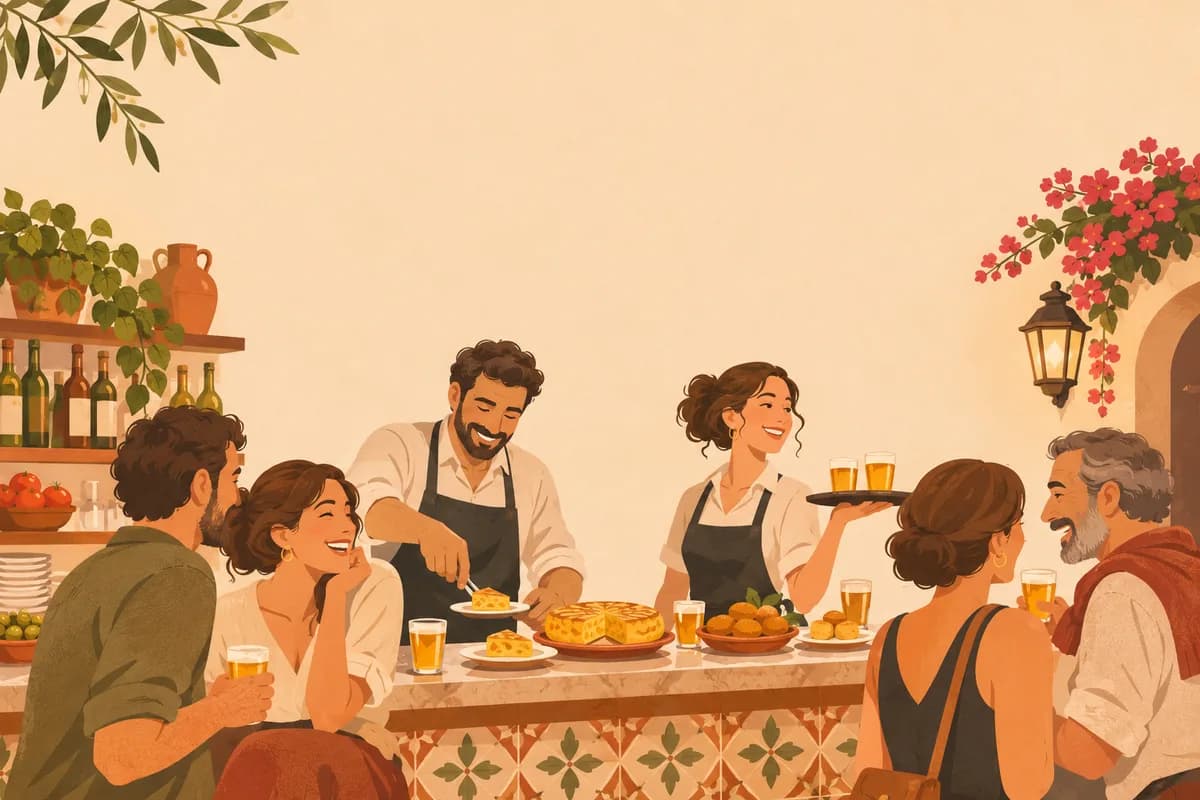
Nine p.m. on a Friday at a tapas bar in Madrid. The bar counter is packed with people standing, beer glasses on the counter, and you're trying to hear three people ordering at once: 「Dos cañas」, 「una de bravas」, 「¿me pones otra?」. Nobody says a full 「por favor」, but everyone is polite in their own way. You studied a textbook about restaurants, and it says nothing about listening at a bar counter.
Spanish at a bar is not the Spanish in books. Staff in Spain often use tú or vosotros with young guests, call dishes by short names like caña or ración, and many things are paid for their own way: guests usually pay once at the end of the night. This article uses a tapas counter in Spain as the setting, with a table of differences from Latin America, and it works if your place in Vietnam has guests who speak Spanish.
The article has vocabulary tables by stage at the bar counter and at the table, four grammar points that repeat every shift, and three situations: tapas counter, set lunch, paying the bill. At the end: how to practice listening at fast speed and a word set you can use in the game right away.
- A tapas counter in Madrid: how to order
- Vocabulary by stage at the counter and at the table
- Four grammar points at the counter and at the table
- Three situations: tapas counter, set lunch, paying the bill
- Practice listening at fast speed
- Q&A about Spanish-speaking guests
- A small exercise
A tapas counter in Madrid: how to order
In Spain, the bar counter is both for drinking and for eating. Guests stand at the counter and order 「una caña」 (a small glass of draft beer) or 「un vermut」, then order small dishes: tapa, pincho, or ración. In some cities a tapa comes free when you order a drink; elsewhere it's charged separately. Sitting at a table in the comedor is usually for a main meal, like menú del día at lunch.
| Where guests choose | What guests usually order | Common way of paying |
|---|---|---|
| la barra (counter) | caña, vermut, tapa, pincho | pay at the end, stand and drink |
| la terraza (outdoor seating) | beer, tinto de verano, ración | price may be higher than at the counter |
| el comedor (dining room) | menú del día, plato principal | priced per meal, drinks extra |
On tips: in Spain tips are usually small and optional; many guests only leave a little change. Many Latin American countries have a habit of leaving propina, and sometimes the bill shows a suggested amount. You should never demand a tip, but it's worth knowing so you recognize when a guest says 「Quédese con el cambio」.
Another note is regional differences. The table below groups a few common pairs, and the in-game word set uses words understood in most places.
| What you need to say | Spain | Many Latin American countries |
|---|---|---|
| waitstaff | camarero, camarera | mesero, mesera |
| fruit juice | zumo | jugo |
| starter | entrante | entrada |
| straw | pajita | popote (Mexico), pitillo (Colombia) |
| enjoy your meal | Que aproveche | Buen provecho |
On forms of address: young bars in Spain often use tú and vosotros (¿Qué os pongo?). In Latin America and with older guests, usted and ustedes are the safe default. If you're not sure, start with usted and let the guest speak first to switch.
Vocabulary by stage at the counter and at the table
The forty-two words of the in-game word set are in the tables below, plus a few extra words the situations need like la tapa, la ración, la caña, el vermut, and el datáfono. Nouns include the article, because masculine and feminine gender drive most of the rest of the sentence. The meaning column uses the same style of explanation as the word set.
Welcoming guests, counter, table, and seating
| Word | Meaning | Example sentence | Translation |
|---|---|---|---|
| el cliente, la clienta | guest, customer | Los clientes de la barra suelen pagar al final. | Guests at the counter usually pay at the end. |
| el camarero, la camarera | waiter, waitress (in Latin America people often say mesero) | El camarero le pone la tapa con la caña. | The waiter brings you the tapa with your beer. |
| el cocinero | chef, cook | El cocinero prepara las raciones a medida que se piden. | The cook prepares the raciones as they're ordered. |
| el bartender | bar staff who make drinks | El bartender prepara un vermut con hielo y naranja. | The bartender makes a vermut with ice and orange. |
| la cocina | kitchen | La cocina cierra a las cuatro y abre otra vez a las ocho. | The kitchen closes at 4 p.m. and opens again at 8 p.m. |
| la mesa | table (where guests sit) | Esa mesa es solo para comer, en la barra se puede picar. | That table is only for a main meal; at the counter you can snack. |
| la reserva | reservation | Tengo una reserva para las nueve y media. (guest speaking) | I have a reservation for 9:30. |
| la terraza | outdoor terrace | En la terraza se paga un poco más que en la barra. | On the terrace you pay a bit more than at the counter. |
| el comedor | indoor dining room | El comedor del fondo es para el menú del día. | The dining room at the back is for the set lunch menu. |
| la barra | bar counter | En la barra puede tomar una tapa de pie. | At the counter you can have a tapa standing up. |
| la tapa | small dish with a drink | La tapa de hoy es tortilla de patatas. | Today's tapa is potato omelette. |
| la ración | large portion to share among several people | Una ración es para compartir, media ración es más pequeña. | One ración is to share; half a ración is smaller. |
| el pincho | small dish on a skewer (Northern Spain style) | Los pinchos están en la barra, se cuentan por palillos. | Pinchos are at the counter; they're counted by skewers. |
Nouns for jobs often have two forms: el camarero and la camarera, el cliente and la clienta. el cocinero becomes la cocinera, and el bartender is used for both genders. When calling staff, guests usually say 「Perdona」 or 「Por favor」 and rarely use the job title.
Menu, dishes, and tastes
| Word | Meaning | Example sentence | Translation |
|---|---|---|---|
| la carta | menu | La carta de vinos está en la última página. | The wine list is on the last page. |
| el entrante | starter (in Latin America people often say entrada) | De entrante pueden pedir unas croquetas para compartir. | For a starter you can order some croquetas to share. |
| el plato principal | main course | El plato principal viene con patatas fritas o ensalada. | The main course comes with fries or salad. |
| el postre | dessert | El postre incluye flan, helado o fruta. | Dessert includes flan, ice cream, or fruit. |
| vegetariano | vegetarian | La tortilla de patatas es vegetariana, lleva huevo y cebolla. | Potato tortilla is vegetarian; it has egg and onion. |
| la alergia | food allergy | Si tiene alergia a los frutos secos, avíseme. | If you're allergic to nuts, please tell me. |
| picante | spicy | Las patatas bravas llevan una salsa un poco picante. | Patatas bravas come with a slightly spicy sauce. |
| fresco | fresh | La fruta del postre es fresca, de temporada. | Dessert fruit is fresh, in season. |
| agotado | sold out | El pulpo está agotado, pero queda calamar. | Octopus is sold out, but there's still squid. |
| el menú del día | set lunch menu, fixed price | El menú del día se sirve de lunes a viernes. | The set lunch menu is served Monday through Friday. |
| sin gluten | gluten-free | Esta cerveza es sin gluten. | This beer is gluten-free. |
| el punto | doneness of meat | El punto de la carne puede ser poco hecha, al punto o muy hecha. | Meat doneness can be rare, medium, or well done. |
The two words el entrante and el menú del día are easy to mix up. Entrante is a starter, and menú del día in Spain is usually a full set meal with a first course, second course, and dessert. The word agotado is often replaced in speech by 「Ya no queda」, and you should get used to hearing both.
Drinks and utensils
| Word | Meaning | Example sentence | Translation |
|---|---|---|---|
| el café | coffee | ¿Café solo, cortado o con leche? | Black coffee, coffee with a splash of milk, or coffee with milk? |
| el té | tea | El té se sirve con limón. | Tea is served with lemon. |
| la cerveza | beer | La cerveza de barril sale muy fría. | Draft beer comes out very cold. |
| el cóctel | cocktail | El cóctel de la casa lleva ginebra y pepino. | The house cocktail has gin and cucumber. |
| el zumo | fruit juice (in Latin America people often say jugo) | El zumo de naranja es natural, recién exprimido. | Orange juice is fresh, just squeezed. |
| el hielo | ice (ice cubes) | ¿Le pongo hielo en el vermut? | Shall I put ice in your vermut? |
| el agua mineral | bottled mineral water | El agua mineral viene en botella de medio litro. | Mineral water comes in a half-liter bottle. |
| los palillos | chopsticks | ¿Palillos chinos o palillos de dientes? | Chopsticks or toothpicks? |
| el tenedor | fork | Para la tortilla le traigo un tenedor. | For the tortilla I'll bring you a fork. |
| el cuchillo | knife | El cuchillo es para el filete. | The knife is for the steak. |
| la cuchara | spoon | La cuchara es para el gazpacho. | The spoon is for the gazpacho. |
| el plato | plate | Le pongo un plato pequeño para compartir. | I'll set a small plate for you to share. |
| el vaso | glass (for drinking) | Un vaso de agua del grifo, por favor. (guest speaking) | A glass of tap water, please. |
| la servilleta | napkin | Las servilletas de papel están en el servilletero. | Paper napkins are in the napkin holder. |
| la caña | small glass of draft beer (Spain) | Una caña es un vaso pequeño de cerveza de barril. | A caña is a small glass of draft beer. |
| el tinto de verano | red wine mixed with fizzy soft drink | El tinto de verano es vino tinto con gaseosa. | Tinto de verano is red wine with fizzy soda. |
| el vermut | vermouth | El vermut se toma antes de comer, con una aceituna. | Vermut is usually drunk before eating, with an olive. |
| la pajita | straw (in Mexico it's popote) | La pajita es de papel. | The straw is paper. |
| de barril | (beer) on tap from a keg | Tenemos cerveza de barril y de botella. | We have draft beer and bottled beer. |
The word palillos is easy to confuse: it means both chopsticks and toothpicks. When a guest asks for 「palillos」, ask back 「¿chinos o de dientes?」. The pair con gas and sin gas shows up every time someone orders mineral water.
Taking orders and fixed phrases
| Word | Meaning | Example sentence | Translation |
|---|---|---|---|
| el pedido | order, what the guest ordered | El pedido va directo a la cocina. | The order goes straight to the kitchen. |
| tomar nota | take the guest's order | ¿Les tomo nota de las bebidas primero? | Shall I take your drinks first? |
| recomendar | recommend a dish | Les recomiendo pedir tres raciones para compartir. | I recommend ordering three raciones to share. |
| servir | serve food to the table | Servimos la comida de una a cuatro. | We serve meals from 1 to 4 p.m. |
| Phrase in the restaurant | When to use it |
|---|---|
| Buenas tardes, ¿cuántos son? | greeting and asking party size |
| ¿Qué os ponéis? / ¿Qué les pongo? | asking what guests want to order (group of friends / guest group) |
| Marchando. | yes, on it right away (said when taking an order) |
| Un momento, por favor. | please wait a moment |
| Que aproveche. / Buen provecho. | setting down the food, wishing guests a good meal |
| ¿Todo bien por aquí? | checking if everything is okay |
| ¿Les cobro? | asking if they're ready to pay |
The fixed-phrase table above is the part most worth memorizing. 「¿Qué os pongo?」 or 「¿Qué van a tomar?」 sounds much more natural when you say it with the familiar bar-counter intonation.
Paying, tips, and the bill
| Word | Meaning | Example sentence | Translation |
|---|---|---|---|
| la cuenta | bill, check | La cuenta se pide en la barra o a la camarera. | Guests ask for the bill at the counter or from the waiter. |
| la propina | tip | Aquí la propina es voluntaria y suele ser pequeña. | Here the tip is voluntary and usually small. |
| pagar | pay | Se puede pagar al final, no hace falta pagar cada ronda. | You can pay at the end; you don't need to pay after each round. |
| la tarjeta de crédito | credit card | La tarjeta de crédito se pasa por el datáfono. | The credit card is swiped through the card terminal. |
| el efectivo | cash | Si paga en efectivo, ¿tiene cambio de veinte? | If you're paying cash, do you have change from a twenty? |
| el cambio | change returned | Su cambio son seis euros con cincuenta. | Your change is six euros fifty. |
| el recibo | receipt after payment | El recibo se lo doy en mano. | I'll hand you the receipt in person. |
| para llevar | to go | Los pinchos de tortilla también son para llevar. | Tortilla pinchos can be to go too. |
| la factura | full invoice (for a company) | Para la factura necesito el nombre de la empresa. | For a full invoice I need the company name. |
| por separado | separately, each person | ¿Prefieren la cuenta por separado cada uno? | Would you like separate bills for each of you? |
| el datáfono | card reader | Le traigo el datáfono a la mesa. | I'll bring the card terminal to your table. |
| Quédese con el cambio. | keep the change | Aquí tiene veinte, quédese con el cambio. (guest speaking) | Here's twenty; keep the change. |
「La cuenta, por favor」 is what guests say to ask for the bill, and you answer with 「Enseguida se la traigo」. When they need a full invoice, guests use factura instead of recibo, so you need to tell the two words apart. Practice hearing amounts of money very carefully, because one wrong number at the counter is expensive.
Four grammar points at the counter and at the table
1. Usted, tú, and vosotros: choosing how to address guests
In Spain, bar staff usually use tú with one person and vosotros with a group of friends: ¿Qué os pongo? With older guests or in many Latin American countries, you use usted and ustedes, and the verb is conjugated in the third person.
- ¿Qué desea?
- ¿Qué van a tomar?
- ¿Necesitan algo más?
A common mistake for Vietnamese speakers is using tú with older guests because the word is short and feels like 「bạn」. With strangers, start with usted and let the guest speak first to switch.
2. Polite imperatives with usted: pase, siéntese, espere
When inviting or directing, you use the usted imperative: verbs ending in -ar become -e, verbs ending in -er and -ir become -a. Add por favor to soften the sentence.
- Pasen por aquí, por favor.
- Siéntese donde prefiera.
- Espere un momento, por favor.
A common mistake is using the tú imperative like 「Siéntate」 or 「Espera」 with strangers. Use siéntese and espere, and remember the stress mark on siéntese.
3. Ser and estar: es picante, está caliente, está agotado
Ser describes lasting traits of a dish: es picante, es vegetariano. Estar describes the current state: está caliente, está fresco, está agotado.
- Este plato es picante.
- Cuidado, la sopa está muy caliente.
- Ese plato está agotado.
A common mistake is using ser for everything. When a dish is sold out or hot right now, that's a state, so use estar.
4. Pronouns le, les, se lo, se la: what you do for the guest
When you do something for a guest, Spanish puts le (one person) or les (several) before the verb: le traigo, les recomiendo. When there's also something being brought, le becomes se and goes before la, lo: Enseguida se la traigo.
- Le traigo la carta enseguida.
- Les recomiendo el pescado del día.
- Enseguida se la traigo.
A common mistake is dropping the pronoun and saying 「Traigo la carta」, or saying 「le la traigo」. With two pronouns together, remember le and les become se before lo, la.
Three situations: tapas counter, set lunch, paying the bill
Two guests at a tapas counter
Read both roles out loud. Watch the fast intonation and the staff member's vosotros.
| Role | Spanish | Translation |
|---|---|---|
| Staff | Buenas noches, ¿qué os pongo? | Good evening, what can I get you? |
| Guest | Dos cañas y una ración de bravas, por favor. | Two cañas and one ración of bravas, please. |
| Staff | ¿Bravas normales o con alioli? | Regular bravas or with alioli? |
| Guest | Normales. | Regular. |
| Staff | Marchando. ¿Queréis algo más? | On it. Anything else? |
| Guest | De momento no. Luego pediremos unos pinchos. | Not for now. We'll order some pinchos later. |
Three guests eating menú del día
This scene repeats many times every lunch at a casual restaurant.
| Role | Spanish | Translation |
|---|---|---|
| Staff | Buenas tardes, ¿una mesa para tres? | Good afternoon, a table for three? |
| Guest | Sí, para comer el menú del día. | Yes, for the set lunch menu. |
| Staff | Hoy hay lentejas o ensalada de primero, y de segundo pollo asado o merluza. | Today for first course there's lentil soup or salad; for second, roast chicken or hake. |
| Guest | Lentejas, pollo y merluza, por favor. | Lentil soup, chicken, and hake, please. |
| Staff | ¿Y para beber? | And to drink? |
| Guest | Agua y una cerveza. | Water and a beer. |
| Staff | De postre hay flan, fruta o café. | For dessert there's flan, fruit, or coffee. |
Paying the bill
Watch how the guest asks for the bill and how you ask whether to charge together or separately.
| Role | Spanish | Translation |
|---|---|---|
| Guest | La cuenta, por favor. | The bill, please. |
| Staff | Enseguida se la traigo. ¿Les cobro todo junto? | I'll bring it right away. Shall I charge you all together? |
| Guest | Sí, con tarjeta. | Yes, by card. |
| Staff | Aquí tiene el datáfono. ¿Quieren el recibo? | Here's the card terminal. Do you want a receipt? |
| Guest | No, gracias. Estaba todo buenísimo. | No, thanks. Everything was delicious. |
| Staff | Muchas gracias. Que tengan una buena tarde. | Thank you very much. Have a good afternoon. |
Practice listening at fast speed
Start by playing the restaurant word set in Falling Stars or Pop It. Play a few rounds until you can see a word and say the meaning with the right gender, then read each sentence in the tables above out loud, getting faster.
The next step is ear training. Pick an episode from the Spanish podcast, listen sentence by sentence, transcribe, and compare to the original. Transcribing shows you where you drop swallowed final sounds. If you want a path, see the courses, and take the vocabulary test to see where you stand.
Outside WELE, Dreaming Spanish has many slow, easy Spanish videos, and the Real Academia Española (RAE) dictionary helps when you need to check a noun's gender. Both teach general Spanish, so restaurant vocabulary still needs extra practice with this word set. The DELE exam doesn't test specialized restaurant vocabulary. When you want to try your level, DELE mock tests on WELE show you where you stand.
If your work is close to hotels or tour driving, see also Spanish for hotels and Spanish for drivers, or browse all of Spanish by profession and the restaurant and café page.
Q&A about Spanish-speaking guests
Should I learn Spain Spanish or Latin American Spanish?
Learn a standard form first, and know the different word pairs like in the table above. Guests from both regions understand basics like carta, cuenta, and propina, so you don't have to pick one region from the start.
When do I use tú with guests?
With older guests or strangers at an upscale restaurant, use usted. At a young bar in Spain, tú and vosotros are normal, but if you're not sure, usted is the safer choice.
How much do Spanish-speaking guests tip?
There's no single amount, because customs differ by country. Many guests from Latin America are used to leaving propina; guests from Spain usually leave little and it's optional. If you work abroad, ask long-time coworkers about local custom.
What level of Spanish do you need to wait tables in Spain?
There's no single number; it depends on the restaurant, visa type, and role. Front-of-house guest-facing roles usually need higher Spanish than kitchen roles. Ask the employer directly what requirements apply.
What do Spanish guests often ask at a Vietnamese restaurant?
Common questions are 「¿Es picante?」 (is it spicy?), 「¿Tienen platos vegetarianos?」 (do you have vegetarian dishes?), 「¿Tienen zumo natural?」 (do you have fresh juice?), and 「¿Aceptan tarjeta?」 (do you take cards?). Learning answers to these four covers most of the asking.
A small exercise
Play one round of the word set in Falling Stars, then practice saying out loud 「¿Qué van a tomar?」, 「Enseguida se la traigo」, and 「¿Les cobro?」 until they come out of your mouth naturally.
