Spanish for Elder Care: Vocabulary, Grammar, and Conversation
On this page
- Three ways of working: interna, hourly, and in a residencia
- Vocabulary through a caregiver's day
- Family, workplace, and records
- Morning aseo: hygiene, toileting, dressing
- Mesa y comida: meals and drinks
- Cuidar la movilidad: transfers and fall prevention
- Cuando la memoria and mood change
- Five grammar points, from usted to estar
- 1. Usted and formal imperativo
- 2. Ir a + infinitivo and le: announce each action
- 3. ¿Le gustaría...? and ¿Podría...?: polite offers and requests
- 4. Pretérito perfecto when reporting: he comido, se ha caído
- 5. Ser and estar when describing condition
- Three scenarios: first morning, assessment visit, memory workshop
- First morning as cuidadora interna
- Home assessment visit
- Memory workshop at the day center
- Review while working and studying
- Q&A: paperwork, speech, regions
- What level of Spanish do you need to work as a cuidador?
- How does language differ between live-in and hourly work?
- How do cuidador, auxiliar de enfermería, and enfermero differ?
- Should you use usted or tú with clients?
- Is Spanish in Spain very different from Latin America?
- What if the client has a strong regional accent and you can't catch it?
- A small task for the weekend
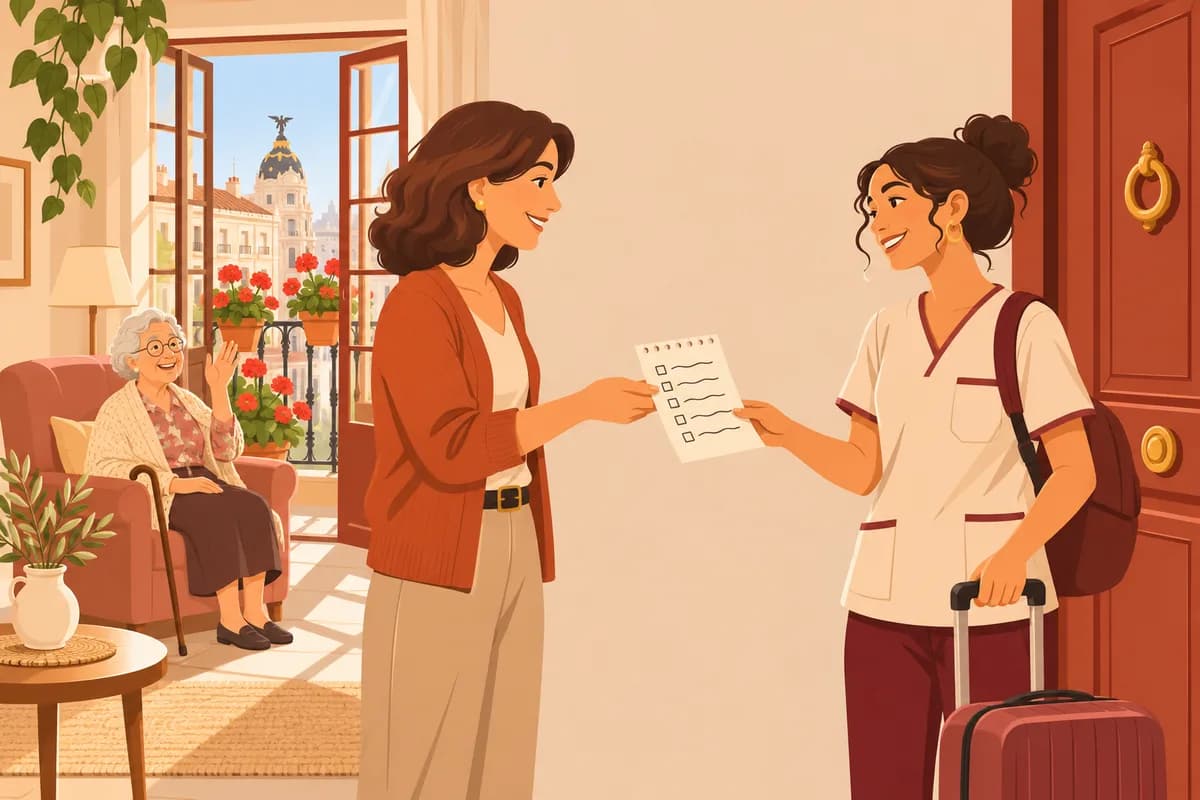
On a Sunday afternoon you drag a suitcase up to the third floor of an apartment in Vallecas, Madrid, where you will live and work as a live-in caregiver (cuidadora interna). The elderly woman's daughter hands you a sheet with schedules, a shopping list, and one last line: 「Mamá toma el café con leche a las ocho, y no le gusta que le hablen muy alto」. She adds more, very quickly, then catches a taxi to work.
Spanish in elderly care often starts like that: one family, one home, and someone who has to grasp small habits right away. In a nursing home it's different, because there is a team, shift rosters, and shared records. This article covers both settings, but leans toward working in a family home, because many Vietnamese people and immigrants work there.
The article is for people learning Spanish to work as a cuidador, gerocultor, or home care worker in Spain and other Spanish-speaking places. Vocabulary follows a caregiver's day, with example sentences and translations. Then come five grammar points, three read-aloud scenarios, and how to review while working and studying. It closes with vocabulary you can use in games right away.
- Three ways of working: live-in, hourly, and in a residencia
- Vocabulary through a caregiver's day
- Five grammar points, from usted to estar
- Three scenarios: first morning, assessment visit, memory workshop
- Review while working and studying
- Q&A: paperwork, speech, regions
- A small task for the weekend
Three ways of working: interna, hourly, and in a residencia
People who care for the elderly in Spain usually work in one of three ways, and each way gives you a different kind of Spanish.
| Way of working | Where you are and what you do | Spanish you use most |
|---|---|---|
| Cuidadora interna | Live in the client's home, handle daily tasks, many hours alone with the client | Long conversations with the client and family, lots of everyday sentences |
| Ayuda a domicilio, hourly | Come to the client's home for a few hours each day, do agreed tasks | Short sentences, schedules, notes |
| Gerocultor in a residencia | Work shifts in a nursing home with many clients and coworkers | Talk with coworkers, supervisor, nurse, and family |
Each client's level of dependency is recognized as grado de dependencia (grado I, II, or III), usually after a valoración by a trabajadora social, and that level ties into state support rights. You don't decide that, but you will hear people mention it when the family talks about the client's file. In a nursing home, each client also has a plan de cuidados listing individual things to watch for.
Vocabulary through a caregiver's day
Five tables follow the day: paperwork and workplace, morning aseo, meals, mobility and safety, then memory and mood. Learn nouns with the article el or la, like la caída, el pañal, because gender affects the whole sentence. When speaking to the client, use natural phrasing like 「Voy a cambiarle」 instead of cambiar el pañal.
Family, workplace, and records
| Word | Meaning | Example sentence | Translation |
|---|---|---|---|
| residente | person living in a nursing home | La residente de la habitación 12 tiene 91 años. | The resident in room 12 is 91 years old. |
| cuidador | caregiver | El cuidador de la tarde prepara la cena y acuesta a doña Rosa. | The afternoon caregiver prepares dinner and puts doña Rosa to bed. |
| gerocultor | care staff in a nursing home (term used in Spain) | En la residencia, el gerocultor ayuda a los residentes con el aseo y las comidas. | In the nursing home, the gerocultor helps residents with personal care and meals. |
| residencia de mayores | nursing home | La residencia de mayores tiene cuatro plantas y un jardín. | The nursing home has four floors and a garden. |
| ayuda a domicilio | home care | La ayuda a domicilio viene de lunes a viernes, una hora por la mañana. | Home care comes Monday to Friday, one hour in the morning. |
| plan de cuidados | care plan | El plan de cuidados indica la hora de levantarse de cada residente. | The care plan lists each resident's wake-up time. |
| registro de cuidados | care log | Todo lo que hago lo anoto en el registro de cuidados. | Everything I do I note in the care log. |
| centro de día | day care center | Don Luis va al centro de día de lunes a viernes y vuelve a casa a las cinco. | Don Luis goes to the day center Monday to Friday and comes home at five. |
| trabajadora social | social worker | La trabajadora social visita la casa para valorar la situación. | The social worker visits the home to assess the situation. |
| grado de dependencia | recognized dependency level (grado I, II, III) | Doña Rosa tiene reconocido un grado II de dependencia. | Doña Rosa has recognized grado II dependency. |
In Spain, staff in nursing homes are usually called gerocultor or gerocultora; in private homes, cuidador or cuidadora. Many immigrants work as cuidadora interna, meaning they live in the same home as the client. That job has very different conditions from facility shifts, so ask carefully about hours and rest and put it clearly in the contract.
Morning aseo: hygiene, toileting, dressing
| Word | Meaning | Example sentence | Translation |
|---|---|---|---|
| aseo | personal hygiene, washing | El aseo de doña Rosa empieza a las ocho. | Doña Rosa's personal care starts at eight. |
| ducha | shower | Hoy toca ducha, porque es martes. | Today it's shower day because it's Tuesday. |
| acompañar al baño | accompany to the toilet | Antes de desayunar, acompaño a don Luis al baño. | Before breakfast, I take don Luis to the bathroom. |
| pañal | adult diaper | Por la noche don Luis usa pañal. | At night don Luis wears a diaper. |
| cambiar el pañal | change the diaper | Hay que cambiar el pañal antes de la comida. | The diaper has to be changed before lunch. |
| vestirse | get dressed | Para ayudarle a vestirse, dejo que elija la ropa. | When helping him dress, I let him choose his clothes. |
| higiene bucal | oral hygiene | Para la higiene bucal usamos un cepillo suave. | For oral hygiene we use a soft brush. |
| dentadura postiza | dentures | Anoche don Luis dejó la dentadura postiza en el baño y la recogí yo. | Last night don Luis left his dentures in the bathroom and I picked them up. |
| ropa de cama | bed linen | La ropa de cama se cambia los lunes, y antes si hace falta. | Bed linen is changed on Mondays, or sooner if needed. |
| intimidad | privacy | Llamo a la puerta antes de entrar, por respeto a su intimidad. | I knock before entering, out of respect for her privacy. |
Aseo also means bathroom in some places, so listen to context: 「el aseo de la mañana」 is morning personal care, while 「¿Dónde está el aseo?」 is asking where the bathroom is. When talking to the client about toileting, people often use 「ir al baño」.
Mesa y comida: meals and drinks
| Word | Meaning | Example sentence | Translation |
|---|---|---|---|
| ayuda para comer | help with eating | Para la ayuda para comer, me siento a su lado y le doy tiempo. | When helping her eat, I sit beside her and give her time. |
| comida triturada | puréed food | Doña Rosa toma comida triturada y agua gelificada. | Doña Rosa has puréed food and gel-thickened water. |
| disfagia | dysphagia, difficulty swallowing | La disfagia le apareció después del ictus; ahora come con espesante. | Dysphagia appeared after her stroke; now she eats with thickener. |
| atragantamiento | choking | Tras un atragantamiento se avisa a la enfermera y se anota la hora. | After choking, the nurse is notified and the time is recorded. |
| hidratación | hydration | La hidratación se vigila sobre todo en verano. | Hydration is monitored especially in summer. |
| pérdida de apetito | loss of appetite | Doña Rosa casi no prueba la sopa desde el lunes y se lo hemos dicho a su hija. | Since Monday doña Rosa has barely touched the soup and we have told her daughter. |
| espesante | liquid thickener | El espesante se añade al agua y se remueve hasta que no queden grumos. | Thickener is added to water and stirred until there are no lumps. |
The verb espesar (to thicken drinks) shows up a lot in the kitchen, along with disfagia. If you hear the client cough hard while eating, stop the meal first and report it; don't wait to see what happens.
Cuidar la movilidad: transfers and fall prevention
| Word | Meaning | Example sentence | Translation |
|---|---|---|---|
| transferencia | transfer from bed to chair or wheelchair | Para la transferencia de la cama al sillón somos dos. | For the transfer from bed to armchair it takes two of us. |
| silla de ruedas | wheelchair | Antes de mover a don Luis, compruebo que los frenos de la silla de ruedas estén puestos. | Before moving don Luis, I check that the wheelchair brakes are on. |
| andador | walker | Con su andador, don Luis llega solo al comedor. | With his walker, don Luis gets to the dining room on his own. |
| grúa | patient lift | La grúa solo se usa después de recibir formación. | The lift is only used after training. |
| barandilla | bed rail | Subir la barandilla es una sujeción y debe estar autorizada y registrada. | Raising the bed rail is a restraint and must be authorized and recorded. |
| úlcera por presión | pressure ulcer | Un enrojecimiento en el talón puede ser el inicio de una úlcera por presión; hay que avisar a la enfermera. | Redness on the heel can be the start of a pressure ulcer; the nurse must be told. |
| caída | fall | Cada caída se anota con fecha, hora y lugar en el registro. | Every fall is logged with date, time, and place. |
| rehabilitación | rehabilitation | La sesión de rehabilitación con el fisioterapeuta es a las dos. | Rehabilitation with the physiotherapist is at two o'clock. |
On barandilla: in Spain raising bed rails is treated as a form of physical restraint (sujeción), so facilities usually need an order or consent from the resident or representative. You don't decide on your own, and it's worth understanding why coworkers ask first. With úlcera por presión, you only describe what you see and tell the nurse.
Cuando la memoria and mood change
| Word | Meaning | Example sentence | Translation |
|---|---|---|---|
| demencia | dementia | Con una persona con demencia, evito las frases largas. | With someone with dementia, I avoid long sentences. |
| pérdida de memoria | memory loss | La hija nota que la pérdida de memoria va a más. | The daughter notices memory loss is getting worse. |
| deambulación | wandering, pacing without a clear purpose | La deambulación es frecuente al atardecer; dejamos el pasillo libre. | Wandering is common at dusk; we keep the hallway clear. |
| agitado | restless, agitated | Don Luis se pone agitado cuando no encuentra su chaqueta. | Don Luis gets agitated when he can't find his jacket. |
| frágil | frail | Doña Rosa está frágil; la ayudamos cada vez que se levanta. | Doña Rosa is frail; we help her every time she stands up. |
| autónomo | independent, able to manage on their own | Doña Rosa es autónoma para peinarse, pero necesita ayuda con los botones. | Doña Rosa can comb her hair on her own but needs help with buttons. |
| actividades de la vida diaria | activities of daily living | Para valorar la dependencia se observan las actividades de la vida diaria. | To assess dependency, activities of daily living are observed. |
| actividad recreativa | recreational activity | La actividad recreativa del jueves es bingo y coro. | Thursday's recreational activity is bingo and choir. |
| audífono | hearing aid | Si don Luis no oye bien, primero miro si el audífono tiene pilas. | If don Luis doesn't hear well, the first thing I check is whether the hearing aid has batteries. |
| tranquilizar | reassure, calm | Cuando se pone nerviosa, le hablo bajito y le cojo la mano para tranquilizarla. | When she gets anxious, I speak softly and take her hand to reassure her. |
| asistir | assist, help | Asisto a don Luis hasta que llega a su sillón. | I assist don Luis until he reaches his armchair. |
Notice agitado, frágil, and autónomo in the examples: they go with estar or ser depending on what you mean. In care, autónomo means keeping the person doing what they still can, not leaving them to cope alone.
Five grammar points, from usted to estar
1. Usted and formal imperativo
With clients you use usted and address them as don or doña plus name. Instructions use the formal imperativo: -ar verbs switch to -e, -er and -ir to -a, and reflexive pronouns attach after the verb.
- Siéntese aquí, por favor.
- Levante el brazo, por favor.
- Agárrese de mi brazo.
A common mistake for Vietnamese speakers is using the tú form: 「Siéntate」, 「Levanta el brazo」. It sounds friendly but with older people it's rude. The second mistake is pronoun placement: in affirmative commands the pronoun goes after the verb (siéntese); in negative commands it goes before (no se levante).
2. Ir a + infinitivo and le: announce each action
Caregivers often say what they will do before touching the client. The most familiar pattern is ir a plus infinitive. The person receiving the action appears through le, and body parts take the article, not a possessive adjective.
- Voy a ayudarle a levantarse.
- Le lavo la espalda.
- Voy a cerrar la puerta.
Common mistakes are saying 「Lavo su espalda」 word-for-word from Vietnamese, or staying silent to go faster and startling the client. In Spanish, body parts use the definite article; le shows whose body it is.
3. ¿Le gustaría...? and ¿Podría...?: polite offers and requests
When you want to invite the client to do something, use ¿le gustaría? or ¿quiere? as questions. For heavier requests, use ¿podría? in the conditional so the sentence sounds softer.
- ¿Le gustaría ir al baño?
- ¿Podría levantar el brazo?
- ¿Prefiere el té o el café?
A frequent mistake is using 「Tiene que」 or 「Tienes que」 to instruct, it sounds like an order. With clients, turn it into a question or use imperativo with por favor. Spanish speakers also often use diminutives like un ratito, un sorbito, despacito to warm up speech. Used in moderation that's good; on every sentence the client may feel treated like a child.
4. Pretérito perfecto when reporting: he comido, se ha caído
When telling coworkers about something that happened on today's shift, people in Spain often use pretérito perfecto: present haber plus past participle. Something yesterday or earlier uses pretérito indefinido, like 「ayer hubo una caída」.
- Doña Rosa ha comido poco.
- Don Luis se ha levantado dos veces.
- Doña Pilar se ha caído en el pasillo.
Common mistakes are using indefinido for everything, saying 「Comió poco esta mañana」, or wrong reflexive placement (「Ha caído se」). In Latin America people often use indefinido for today's events too, so there you may hear 「Se cayó hace un rato」. Both are correct in their place.
5. Ser and estar when describing condition
For temporary state, use estar: está agitada, está cansado, está muy frágil. Lasting traits or identity use ser: es autónoma, es residente. In records, terse notes often drop both and list keywords.
- Doña Rosa está agitada esta tarde.
- Don Luis es residente de la planta dos.
- Doña Pilar es autónoma para comer.
The classic mistake for Vietnamese speakers is ser for everything: 「Ella es agitada」 sounds like a personality trait, when you mean she is restless this afternoon. Records need this right, because personality comments don't belong there.
Three scenarios: first morning, assessment visit, memory workshop
The three sections below are three different settings. Nguyễn is the learner. Read both roles, then cover the translation column and repeat Nguyễn's lines from memory.
First morning as cuidadora interna
| Role | Spanish | Translation |
|---|---|---|
| Daughter (Marta) | Buenos días, Nguyễn. Mamá se levanta a las ocho y toma café con leche. No le gusta que le hablen muy alto. | Good morning, Nguyễn. My mother gets up at eight and has coffee with milk. She doesn't like people speaking loudly to her. |
| Nguyễn | Entendido. ¿Toma alguna medicación por la mañana? | Understood. Does she take any medication in the morning? |
| Marta | Sí, las pastillas están en el pastillero. Usted solo se las recuerda y ella las toma. | Yes, the pills are in the pill organizer. You just remind her and she takes them herself. |
| Nguyễn | Perfecto. ¿Qué hago si no quiere desayunar? | Perfect. What should I do if she doesn't want breakfast? |
| Marta | Insista un poco, pero sin forzarla. Y apúnteme en la libreta lo que come. | Encourage her a little, but don't force her. And note in the notebook what she eats for me. |
| Nguyễn | Lo anoto en el registro. ¿Puede darme su teléfono por si surge algo? | I'll note it in the log. Can you give me your phone number in case something comes up? |
| Marta | Claro. Llámeme a cualquier hora. | Of course. Call me any time. |
What's worth remembering is how Nguyễn asks ahead about what might happen (「¿Qué hago si no quiere desayunar?」). When you live in the home, questions like that on day one help you avoid situations you don't know how to handle when you're alone with her.
Home assessment visit
| Role | Spanish | Translation |
|---|---|---|
| Social worker (Pilar) | Buenos días, doña Rosa. Soy Pilar, de los servicios sociales. Vengo a hacerle unas preguntas para valorar cómo está. ¿Le parece bien? | Good morning, doña Rosa. I'm Pilar, from social services. I've come to ask you a few questions to assess how you're doing. Is that all right? |
| Doña Rosa | Sí, pase. | Yes, come in. |
| Pilar | ¿Puede levantarse sola de la silla? | Can you stand up from the chair on your own? |
| Doña Rosa | Con el andador, sí. Pero me cuesta. | With the walker, yes. But it's hard. |
| Pilar (to Nguyễn) | ¿Usted la ayuda a ducharse? | Do you help her shower? |
| Nguyễn | Sí. Le lavo la espalda y las piernas, y ella se lava la cara y los brazos. | Yes. I wash her back and legs, and she washes her face and arms. |
| Pilar | Muy bien. ¿Se ha caído alguna vez este año? | Very good. Have you fallen at all this year? |
| Doña Rosa | Una vez, en el baño, en marzo. | Once, in the bathroom, in March. |
| Nguyễn | Fue en marzo. Se hizo daño en la rodilla y fuimos al centro de salud. | It was in March. She hurt her knee and we went to the health center. |
In this visit the caregiver holds the daily detail: who does what when bathing, who fell when. Nguyễn answers in short sentences with concrete tasks (le lavo la espalda, ella se lava la cara), and lets doña Rosa answer her own part. That helps the file reflect real independence.
Memory workshop at the day center
| Role | Spanish | Translation |
|---|---|---|
| Nguyễn | Buenas tardes a todos. Hoy hacemos el taller de memoria. Don Luis, ¿le gustaría sentarse aquí, cerca de la ventana? | Good afternoon, everyone. Today we're doing the memory workshop. Don Luis, would you like to sit here, near the window? |
| Don Luis | Prefiero allí, donde está la radio. | I prefer over there, where the radio is. |
| Nguyễn | Claro, vamos allí. ¿Quién me dice qué canción es esta? | Sure, let's go there. Who can tell me what song this is? |
| Doña Pepa | Es de cuando yo era joven. Mi marido la silbaba. | It's from when I was young. My husband used to whistle it. |
| Nguyễn | Qué bonita historia. ¿Cómo se llamaba su marido, doña Pepa? | What a lovely story. What was your husband's name, doña Pepa? |
| Doña Pepa | Manuel. Se llamaba Manuel. | Manuel. His name was Manuel. |
| Nguyễn | Me alegra que nos lo cuente. Tómese su tiempo. | I'm glad you're telling us. Take your time. |
This exercise is close to terapia de reminiscencia: using songs, photos, or familiar food so clients remember and tell stories. The facilitator doesn't correct wrong memories, only follows up with open questions (¿Cómo se llamaba...?). For you, that's also a very good source of everyday vocabulary.
Review while working and studying
Play the care vocabulary deck in Falling Stars or Pop It. Play until words and gender feel familiar, then read the example sentences aloud.
Next, listening. Pick an episode from the Spanish podcast, pause after each sentence to transcribe, then check against the original. Transcribing shows where your ear drops things, especially short pronouns like le and se that speakers swallow fast. When you want a structured course, see courses, and use the vocabulary test to see where you stand. For exams, DELE mock tests on WELE are timed practice runs.
Beyond WELE: Instituto Cervantes has Aula Virtual de Español (AVE), and many Spanish courses for immigrants run by social organizations and local community centers. In Spain, training for caring for dependent people, such as professional certificates in social and health care for dependents, has its own curricula, and that's the best source of field vocabulary. Ask the training center or employer what level of Spanish they require and which documents they accept.
Live-in workers have hours when the client naps; hourly workers have gaps between homes. Fifteen minutes reading a table aloud in those windows often sticks better than one long weekend session. For related trades, see also Spanish for nursing and Spanish for dentistry, or the full Spanish by profession series and the elderly care page.
Q&A: paperwork, speech, regions
What level of Spanish do you need to work as a cuidador?
It depends on the workplace and who you care for. For home care, a few hundred words on the body, eating, medication, and mobility already helps a lot. For nursing homes and formal training courses, ask the employer or training center what requirements apply now.
How does language differ between live-in and hourly work?
Live-in, you talk at length with the client and family, so you need more everyday sentences, asking what they want to eat or what music they like. Hourly or residencia work uses shorter sentences, more schedules and notes. Choose vocabulary to match the way you'll work.
How do cuidador, auxiliar de enfermería, and enfermero differ?
Cuidador and gerocultor handle daily living: bathing, eating, mobility, dressing. Auxiliar de enfermería assists nursing under a nurse's coordination. Enfermero does clinical tasks like injections or IV fluids. For more on nursing, see Spanish for nursing.
Should you use usted or tú with clients?
Use usted unless the client or family explicitly asks for tú. Address them as don or doña plus name. Many clients prefer that over abuelo or abuela.
Is Spanish in Spain very different from Latin America?
Sentence structure and most care vocabulary are the same. The biggest difference you'll notice is past tense use (ha comido in Spain, comió in much of Latin America) and some local words. Learn for the region where you'll work, and ask coworkers which words they actually use.
What if the client has a strong regional accent and you can't catch it?
That happens often. In Andalucía and the Caribbean many people drop final s sounds. Ask again with 「Perdone, ¿puede repetirlo, por favor?」 and get a coworker to explain afterward. Gradually you'll get used to common local words at your workplace.
A small task for the weekend
This weekend, write down three open questions from the memory workshop (¿Cómo se llamaba...?, ¿Quién me dice...?, ¿De cuándo es...?) and try asking an older person you know, even in your own language, to see which question opens a conversation. Then play one round of Falling Stars.
